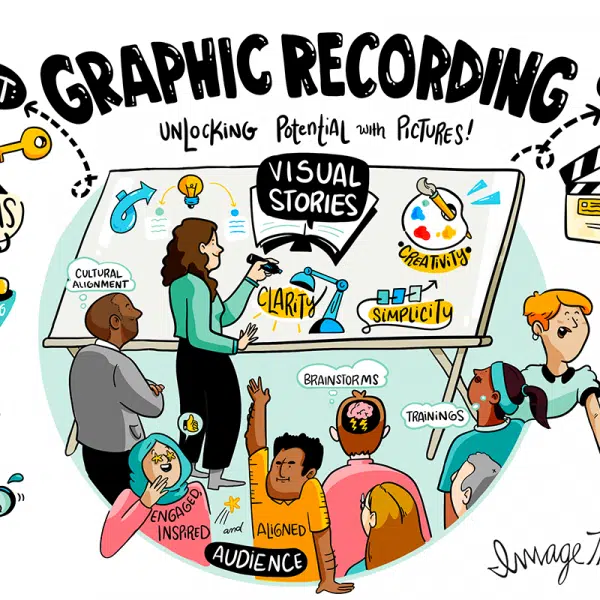
What is Visual Strategy?
Visual strategy is a strategic approach to working visually to improve communication, spark creativity, and unlock clearer thinking. It turns complex ideas, meetings, and conversations into visual formats that are easier to understand, remember, and act on. By working visually, organizations boost collaboration, increase engagement, and accelerate planning and execution. You do not need to be an artist to begin: with a few simple tools and exercises, any team can start thinking and working visually today.
What is a Visual Strategist?
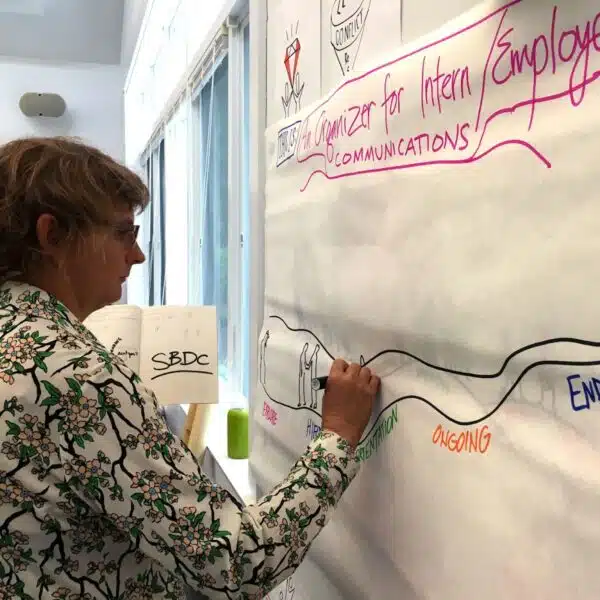
A visual strategist is more than just a graphic designer, illustrator, or graphic recorder. Visual strategists are facilitators who use graphic recording as a tool to visually synthesize ideas during planning sessions, meetings, and events of all kinds. ImageThink has developed a proven methodology that incorporates design thinking principles, gestalt theory, and graphic facilitation practices to help teams of all sizes work better and turn big ideas into measurable action.
Benefits of Practicing Visual Strategy
The human brain processes visual information quickly, which is why we recognize logos, faces, and symbols almost instantly. Working visually helps teams grasp complex ideas faster and communicate them more clearly.
Drawing and viewing pictures engages more areas of the brain and helps us communicate complex ideas more clearly and quickly. What’s more, strategic visuals help to create visual mnemonics that associate key ideas in more areas of the brain, making things more memorable.
During a brainstorm or strategy session, strategic visuals encourage participants to make otherwise unseen connections between ideas. This promotes creative thinking, collaboration and across-the-board engagement since everyone can see the big picture.

Founded as a graphic recording agency, ImageThink has been elevating and expanding the use of visual strategy for our clients for 17+ years. From agenda design to facilitation; from concept illustration to explainer animation, we help our clients to think and work visually. The culmination of these years of experience is The ImageThink Method™.
Visual Strategy vs Graphic Recording: What is the Difference?
Graphic recording captures a conversation visually in real time, producing a live visual summary of a single session. Visual strategy is the broader practice of planning and applying visual thinking across an entire initiative, using graphic recording, visual facilitation, and visual storytelling together. Put simply, graphic recording is one tool a visual strategist uses within a larger visual strategy. That is why a visual strategist is more than a graphic recorder: they listen, structure, and translate conversations so teams align and turn big ideas into measurable action.
The ImageThink Method™ of Visual Strategy
Uniquely developed to help lead organizational transformations, from culture shifts to strategic plans to launching a new brand, this proprietary framework applies visual theory, graphic facilitation, and design thinking in strategic ways to move major initiatives forward.
The ImageThink Method™ divides every project into six clearly defined phases, each of which can be approached visually. Cyclical by nature, this methodology ensures that ideas are captured and carried forward throughout a project, for maximum impact. The resulting visual record ensures nothing is left behind.
The end result isn’t just a successful project, but a more engaging, collaborative, and creative process.
How to Start Thinking and Working Visually
What Form Do Strategic Visuals Take?
At ImageThink, our entire process is visual, from planning to delivery, and even in closing out a client engagement. During the planning stages of a project, our strategic visuals usually take the form of a whiteboarding session, post-its, and a series of visual exercises, captured live with graphic recording.
ImageThink strategic visuals can be created with clients in-person on site, online, or in hybrid environments. The resulting visuals can be large physical boards, or scalable digital images that can be further manipulated and repurposed. A strong visual strategy will include working visually in real time, as well as more planned visual communications in the long term.
For clients working through later phases of The ImageThink Method™, strategic visuals take a more narrative form. Often these are more refined, more fully illustrated, and in some cases animated. The goal here is communication: either of a fully formed plan, or to aid with the internal or external marketing of an idea or initiative.
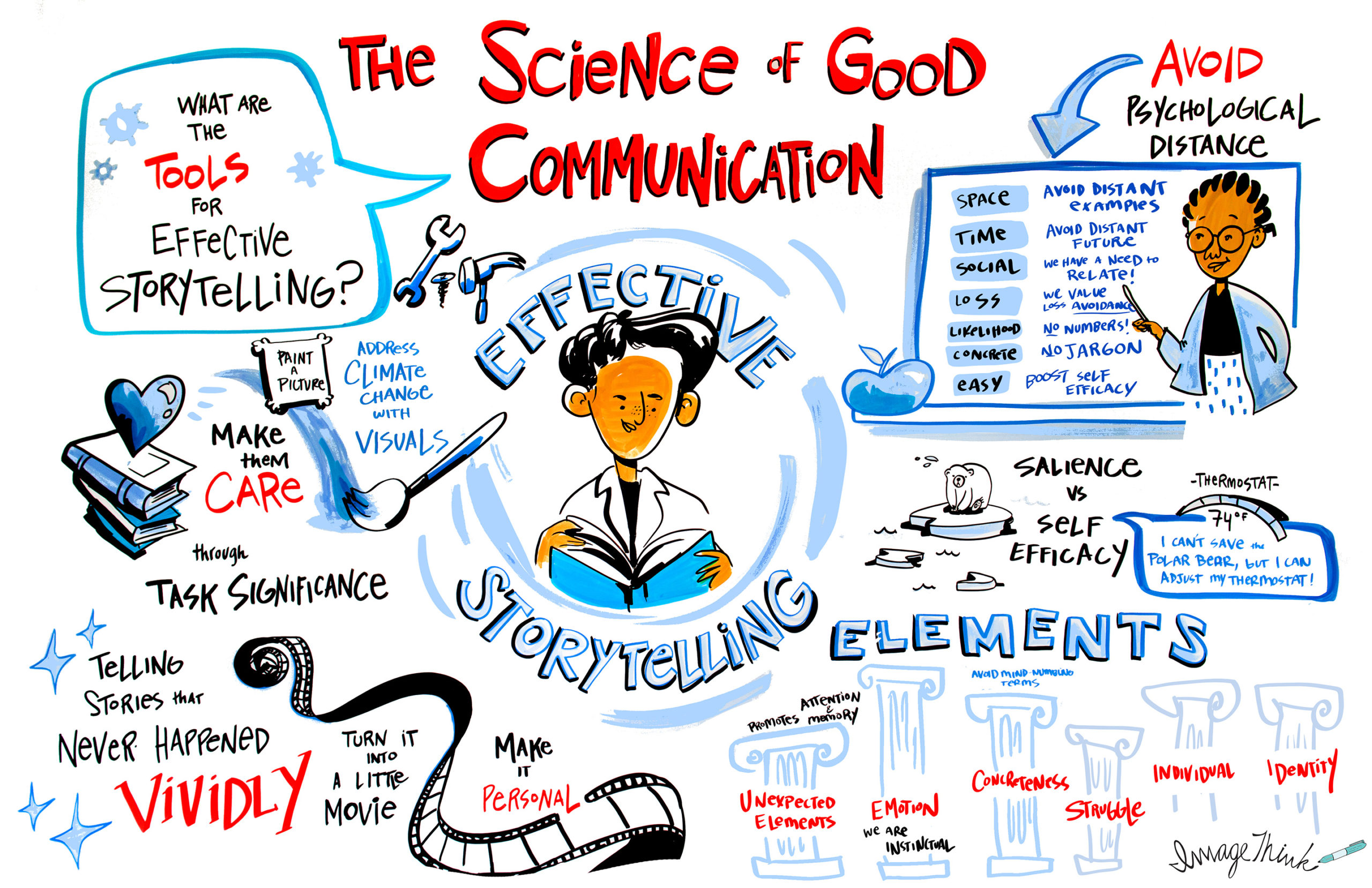
6 Visual Strategies for Improving Your Communication, Innovation, and Collaboration
- Work interactively. Whether in-person, virtual, or in a hybrid environment, create spaces and provide tools for everyone to show their ideas, rather than just telling them.
- Don’t underestimate simple shapes! Boxes, arrows, circles and stick figures can all serve to get you and your team thinking and working more visually.
- Look for every opportunity to convey a message or idea visually. From a doodle on the back of a napkin, to a chart dropped into the body of an email, to adding a few evocative images to a memo, not only will the message stand out, it will stand for a long time in readers’ memories.
- Remember the fourth rule of brainstorming: encourage everyone to review and combine ideas. By massaging, reshaping, and re-contextualizing existing ideas, something new will often emerge; and patterns are easier to see in pictures.
- Consistency is key. Visual strategy builds on itself as people become accustomed to the language of visuals. Certain symbols and images will gain meaning over time, and teams will develop a shorthand for communicating complex ideas.
- Know one’s limits. Everyone can work visually, but not everyone is a visual strategist. For the biggest projects, look into hiring a professional. A company like ImageThink can help clients design a proper agenda, facilitate a productive and collaborative session, and create polished, professional visuals that will serve for the duration of the project.
Visual Strategist Training and Qualifications
As of now, there’s no school or institution that offers a “Visual Strategist” track. No accredited technical schools or programs. That’s because we’ve sort of invented a new term. As ImageThink developed its services and delivery to go far beyond the standard offerings of graphic recorders or graphic facilitators, we felt the need to adjust our titles accordingly.
The result is something that better communicates and describes what we do, though that comes with the challenge of being unique in our field. Clients have always had little formal guidance hiring a graphic recorder, and the same is true of visual strategists. We truly are unique.
Here is what we can tell you. Each Visual Strategist at ImageThink has completed hundreds of hours of immersive training in order to build the skills necessary to help clients approach their project visually, find the right visual language, and synthesize and visualize their message.
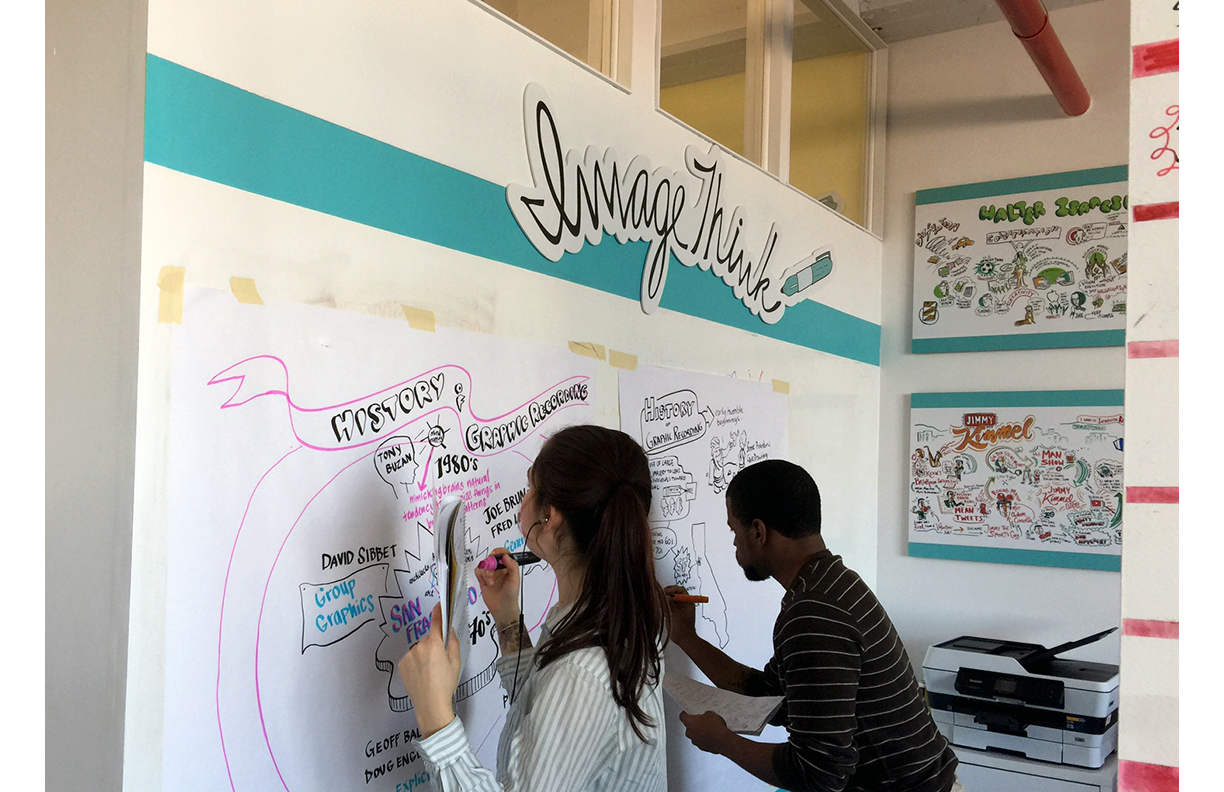
ImageThink Visual Strategists are taught color theory, typographical hierarchy, listening and synthesis skills, visual balance and template design. They practice using real world example sessions and learn hundreds of visual mnemonic devices and icons that you see throughout our boards. And that’s all before going into the field, where our Visual Strategists work with global Fortune 50 companies in the tech, finance, pharma and healthcare, higher education, and so many more. When partnering with ImageThink, you can trust there is no one better positioned to help develop your visual strategy.
Who Uses Visual Strategy?
Visual strategy is useful whenever ideas are complex or teams need to align. Organizations bring it into strategy sessions, OKR and planning kickoffs, leadership and executive meetings, change management and culture initiatives, innovation workshops, product launches, and conferences. In each setting, working visually helps participants see the big picture, contribute their ideas, and leave with a shared visual record that supports follow-through after the session ends.
Frequently Asked Questions About Visual Strategy
What is visual strategy?
Visual strategy is a strategic approach to working visually to improve communication, spark creativity, and unlock clearer thinking. It turns complex ideas, meetings, and conversations into visual formats that are easier to understand, remember, and act on. Organizations use visual strategy to boost collaboration, increase engagement, and accelerate planning and execution across strategy sessions, workshops, and events.
What is a visual strategist?
A visual strategist is a facilitator who uses graphic recording as a tool to synthesize and visualize ideas in real time during meetings, planning sessions, and events. Visual strategists go beyond illustration: they listen, structure, and translate conversations into clear visuals that help teams align, remember key points, and turn big ideas into measurable action.
How is visual strategy different from graphic recording?
Graphic recording captures a conversation visually in real time and produces a live visual summary of a single session. Visual strategy is the broader practice of planning and applying visual thinking across a whole initiative, using graphic recording, facilitation, and visual storytelling together. In short, graphic recording is one tool a visual strategist uses within a larger visual strategy.
What are the benefits of visual strategy?
Visual strategy helps teams process information faster, since the brain understands visuals more quickly than words alone. Working visually encourages participants to see connections between ideas, which supports creative thinking and across-the-board engagement. Strategic visuals also create memorable reference points, so teams retain key ideas and follow through after the meeting or event ends.
When should a team use visual strategy?
Visual strategy is useful whenever ideas are complex or teams need to align. Common moments include strategy sessions, OKR and planning kickoffs, leadership meetings, change management and culture initiatives, innovation workshops, product launches, and conferences. Any time a group needs to think through, communicate, or act on a big idea together, working visually helps.
Do you need to be an artist to practice visual strategy?
No. You do not need to be an artist to start thinking and working visually. Simple shapes like boxes, arrows, circles, and stick figures are enough to help a team work more visually. For major initiatives, many organizations bring in a professional visual strategist to design the agenda, facilitate the session, and create polished visuals.
What is The ImageThink Method?
The ImageThink Method is ImageThink’s proprietary framework for applying visual strategy. It combines visual theory, graphic facilitation, and design thinking, and divides every project into six clearly defined phases that can each be approached visually. Cyclical by design, it helps capture ideas and carry them forward so that nothing is left behind as an initiative moves toward action.
How can my team get started with visual strategy?
You can begin by working more visually in your next meeting: give everyone tools to show ideas rather than only tell them, and capture the discussion with simple visuals. For larger or high-stakes initiatives, ImageThink can help design the agenda, facilitate the session, and create professional visuals. Reach out to start a visual strategy conversation.
Ready to Implement a Visual Strategy?
Now that you know what we mean when we say visual strategy, do you want to unlock your team’s full potential? Contact ImageThink now to get visual!
Ready to Picture Your Big Idea?
"*" indicates required fields