Healthcare conferences move fast. In a single day, attendees absorb policy updates, clinical research, technology innovations, and organizational strategy—often across back-to-back sessions with little time to process. The result is information overload, not insight.
Graphic recording in healthcare changes that dynamic. By capturing complex discussions as real-time visual summaries, graphic recording helps conference attendees understand, retain, and act on what they’ve heard. For more than 17 years, we have partnered with health care and pharmaceutical organizations to bring clarity to their most important conversations—on stages, in strategy sessions, and at conferences around the world.
What Is Graphic Recording in Healthcare?
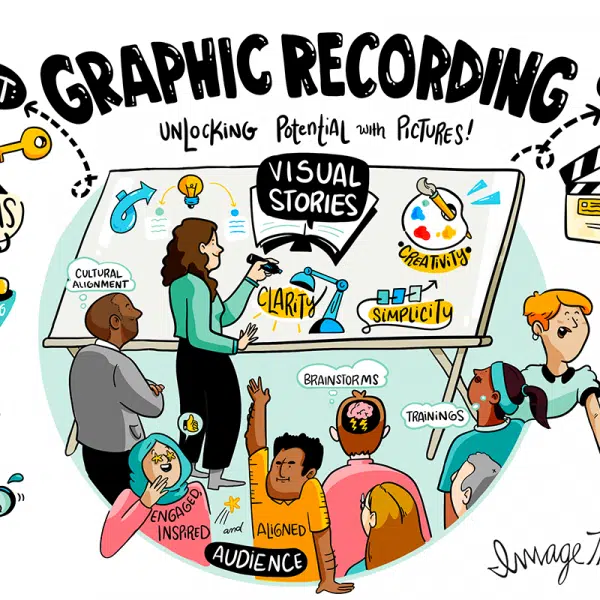
Graphic recording in healthcare is the practice of listening to live presentations, panels, and discussions and translating key ideas into illustrated visual summaries in real time. A trained graphic recorder uses words, icons, color, and spatial organization to synthesize complex content—clinical findings, policy frameworks, patient experience insights—into a single, compelling image the entire audience can see and reference.
It’s not note-taking. It’s meaning-making.

Why Healthcare Conferences Benefit from Graphic Recording
Healthcare conference visualization addresses a problem unique to the sector: the content is dense, the stakes are high, and the audience is time-poor. Physicians, researchers, administrators, and policymakers attend conferences to gain insight they can apply—but without a way to anchor that insight visually, most of it fades within days.
Graphic recording for healthcare conferences gives every session a tangible output. Attendees leave with a visual artifact that captures not just what was said, but why it matters and how it connects to the bigger picture.
The Unique Challenges of Healthcare Communication
Healthcare content is inherently complex. A single conference panel might cover genomic research, reimbursement policy, and patient outcomes simultaneously. Traditional presentation formats—slides, speaker notes, printed summaries—struggle to show how these threads connect.
Visual facilitation in healthcare meets this challenge directly. By illustrating the relationships between ideas as they emerge, a graphic recorder helps audiences see the system, not just the parts. That systems-level clarity is what drives better decisions—and better outcomes.

How Graphic Recording Works During Healthcare Conferences
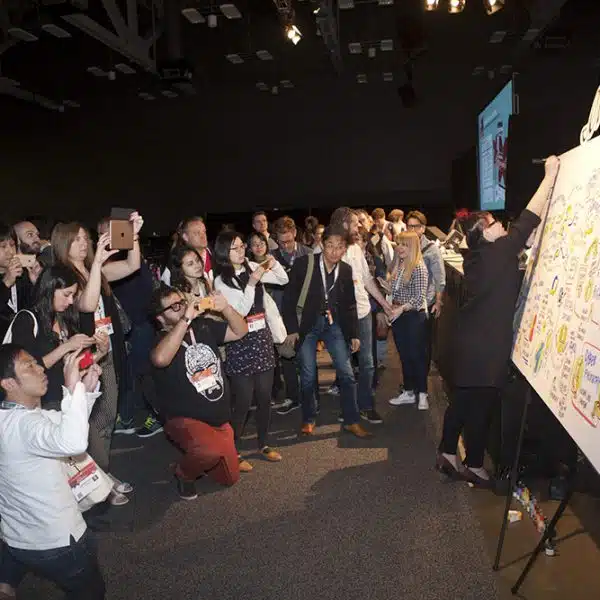
An ImageThink graphic recorder arrives with deep preparation—briefed on the conference themes, key terminology, and session structure. As speakers present and panelists discuss, the graphic recorder listens actively, synthesizing content into visual frameworks in real time on a large-format canvas or digitally on a screen visible to the full room.
The result is a live, evolving visual that grows alongside the conversation. Medical conference graphic recording works precisely because it mirrors the way complex ideas actually develop—not linearly, but in clusters, connections, and moments of synthesis.
How Visual Storytelling Helps Healthcare Professionals
Visual storytelling in healthcare does more than summarize. It reframes. A clinical finding presented as a data point becomes more powerful when illustrated as part of a patient journey. A policy challenge becomes more solvable when mapped visually against its root causes and potential responses.
For healthcare professionals navigating information-dense environments, healthcare visual communication of this kind is a cognitive tool—one that reduces mental load, surfaces pattern recognition, and accelerates understanding across disciplines and roles.
Make Complex Healthcare Ideas Impossible to Forget
Use Cases for Graphic Recording in Healthcare Events
Graphic recording in healthcare serves a wide range of event formats. At large medical conferences, live graphic recording captures keynote addresses and panel discussions, giving thousands of attendees a shared visual reference. In leadership summits and strategy sessions, visual facilitation in healthcare helps executive teams align around organizational priorities. In patient advocacy forums, graphic recording makes complex clinical information accessible to non-specialist audiences. And in medical education and training settings, illustrated visual summaries help learners retain and apply new knowledge long after the session ends.

Benefits of Graphic Recording in Healthcare Conferences
The benefits of graphic recording for healthcare conferences extend well beyond the event itself. During the conference, healthcare conference visualization increases engagement—attendees watch ideas take shape in real time rather than passively absorbing a stream of slides. Healthcare conference engagement rises because participants have something to orient around, react to, and discuss.
After the event, the graphic recording becomes a lasting asset. High-resolution digital editions can be shared with attendees, distributed across internal channels, published on conference websites, and used in follow-up communications. A single graphic recording in healthcare from a day-long conference can generate months of content—extending the reach and impact of the event far beyond the room.
How Conference Organizers Use Graphic Recordings After Events
Graphic recording in healthcare doesn’t end when the conference does. Organizers use finished visual summaries to recap key sessions in post-event communications, onboard colleagues who couldn’t attend, support continuing medical education documentation, and build marketing and thought leadership content for future events.
Medical conference graphic recording also serves an alignment function. When leadership teams, clinical staff, and administrative teams all reference the same visual summary of a strategic discussion, it reduces misinterpretation and keeps the organization moving in the same direction.

Choosing the Right Graphic Recording Partner for Healthcare Events
Not all graphic recorders are equipped for the complexity of healthcare content. The right partner brings more than illustration skills—they bring the ability to listen strategically, distill technical material accurately, and function as a full creative partner in the planning and execution of your event.
ImageThink’s graphic recorders are experienced working across multiple sectors, including healthcare, pharmaceutical, education, and technology. Our team prepares thoroughly for every engagement—learning your content, your audience, and your goals before a single marker touches the canvas. When it comes to graphic recording in healthcare, experience with the sector isn’t a nice-to-have. It’s essential.
Frequently Asked Questions
What is graphic recording in healthcare?
Graphic recording in healthcare is the practice of capturing live conference presentations and discussions as real-time illustrated visual summaries. A trained graphic recorder synthesizes complex clinical, policy, and organizational content into a single compelling image the entire audience can see and reference.
How does graphic recording help conferences?
It gives every session a tangible visual output — something attendees can see, react to, and take away. This improves retention, increases engagement, and creates a shared reference point that supports alignment long after the event ends.
Why use visual facilitation in healthcare events?
Healthcare content is dense and multi-disciplinary. Visual facilitation helps audiences see how complex ideas connect — across clinical, policy, and organizational threads — in ways that slides and speaker notes alone cannot achieve.
What is the difference between graphic recording and visual note-taking?
Visual note-taking is typically a personal practice — an individual capturing ideas for their own reference. Graphic recording is a professional, audience-facing discipline. The graphic recorder synthesizes content for the entire room, creating a shared visual artifact rather than a personal document.
How do visuals improve knowledge retention at conferences?
Research consistently shows that combining visual and verbal information significantly improves retention compared to verbal communication alone. At healthcare conferences, where content density is exceptionally high, visual summaries give attendees cognitive anchors that help them recall and apply what they’ve learned.
Ready to Bring Visual Clarity to Your Next Healthcare Conference?
ImageThink works with healthcare and pharmaceutical organizations to design visual experiences that make complex ideas clear, memorable, and actionable. Contact us to discuss how graphic recording can elevate your next event.
Ready to Picture Your Big Idea?
"*" indicates required fields