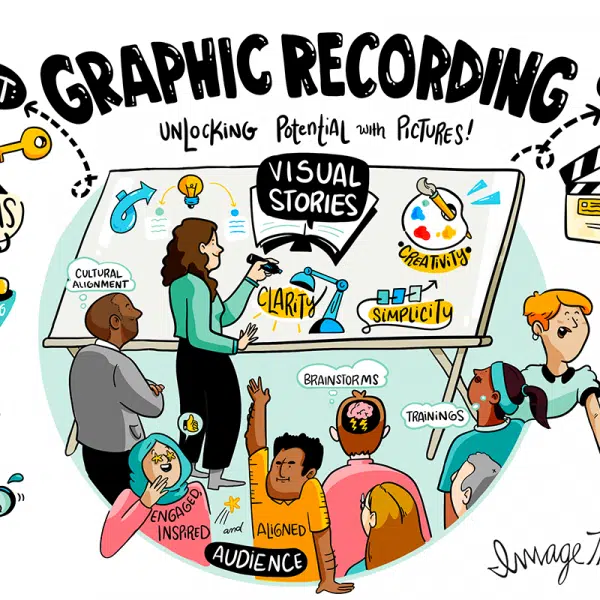
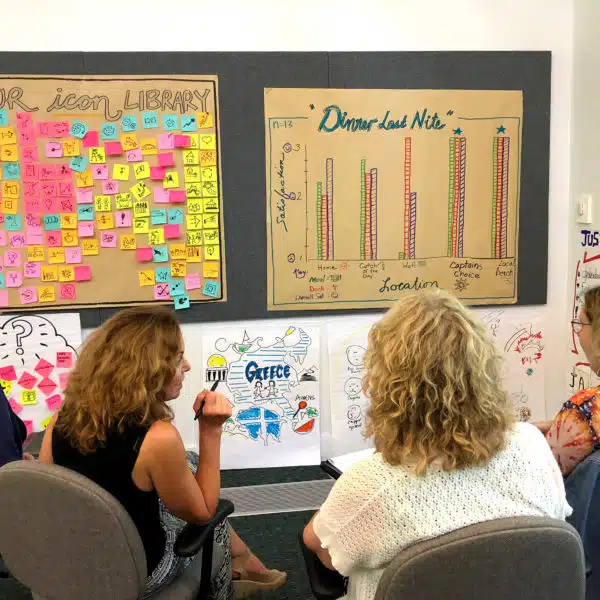
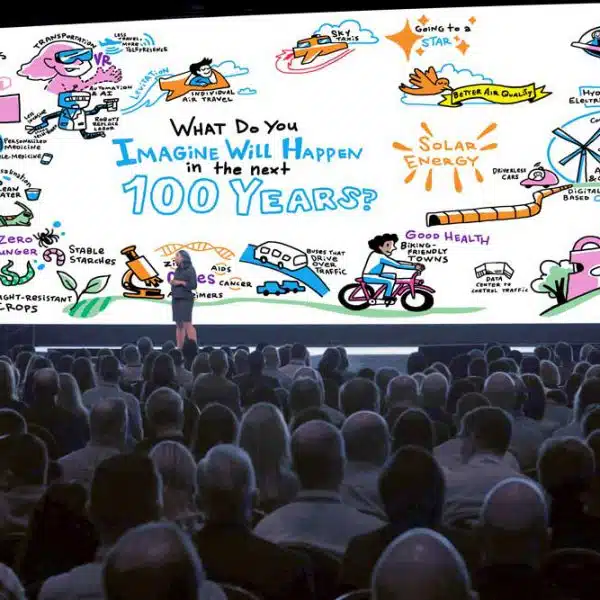
The best way to understand what graphic recording does is to see it. Not described, not summarized — seen. A skilled graphic recorder working on large foamcore boards — sometimes spanning nearly eight feet — translating the energy and complexity of a live conversation into a visual story that the entire room can see, respond to, and remember. Since 2009, ImageThink has created graphic recording examples across thousands of sessions — from Fortune 50 strategy summits and global conferences to nonprofit planning retreats and technology innovation workshops. What we have learned in that time is that the most powerful examples share the same qualities: they listen deeply, distill precisely, and communicate ideas in ways that outlast the room. Whether you are planning your first session or looking to raise the bar on an existing program, these examples offer both inspiration and a practical framework for what great visual capture looks like in practice.
What Graphic Recording Looks Like Across Different Events
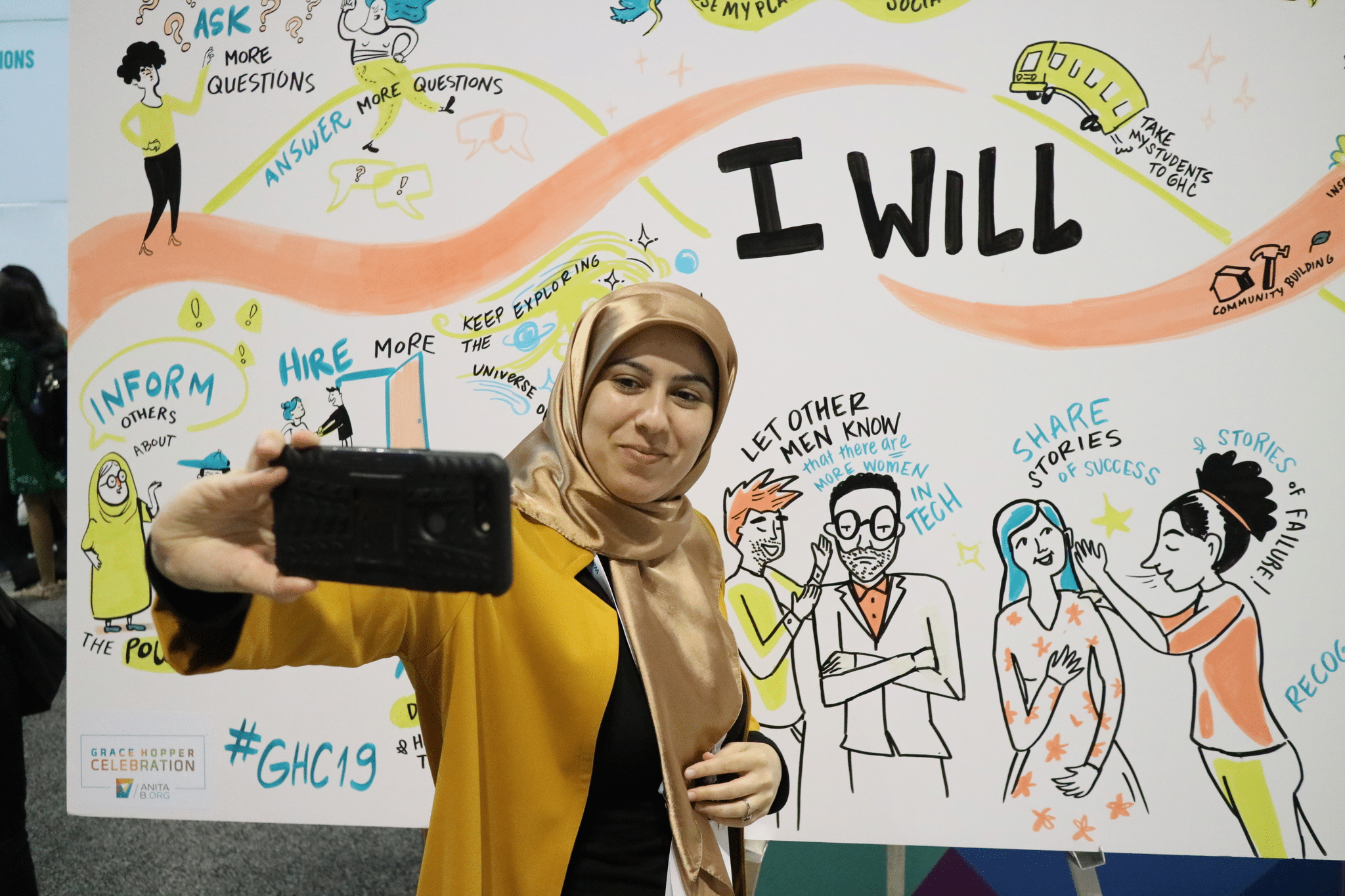
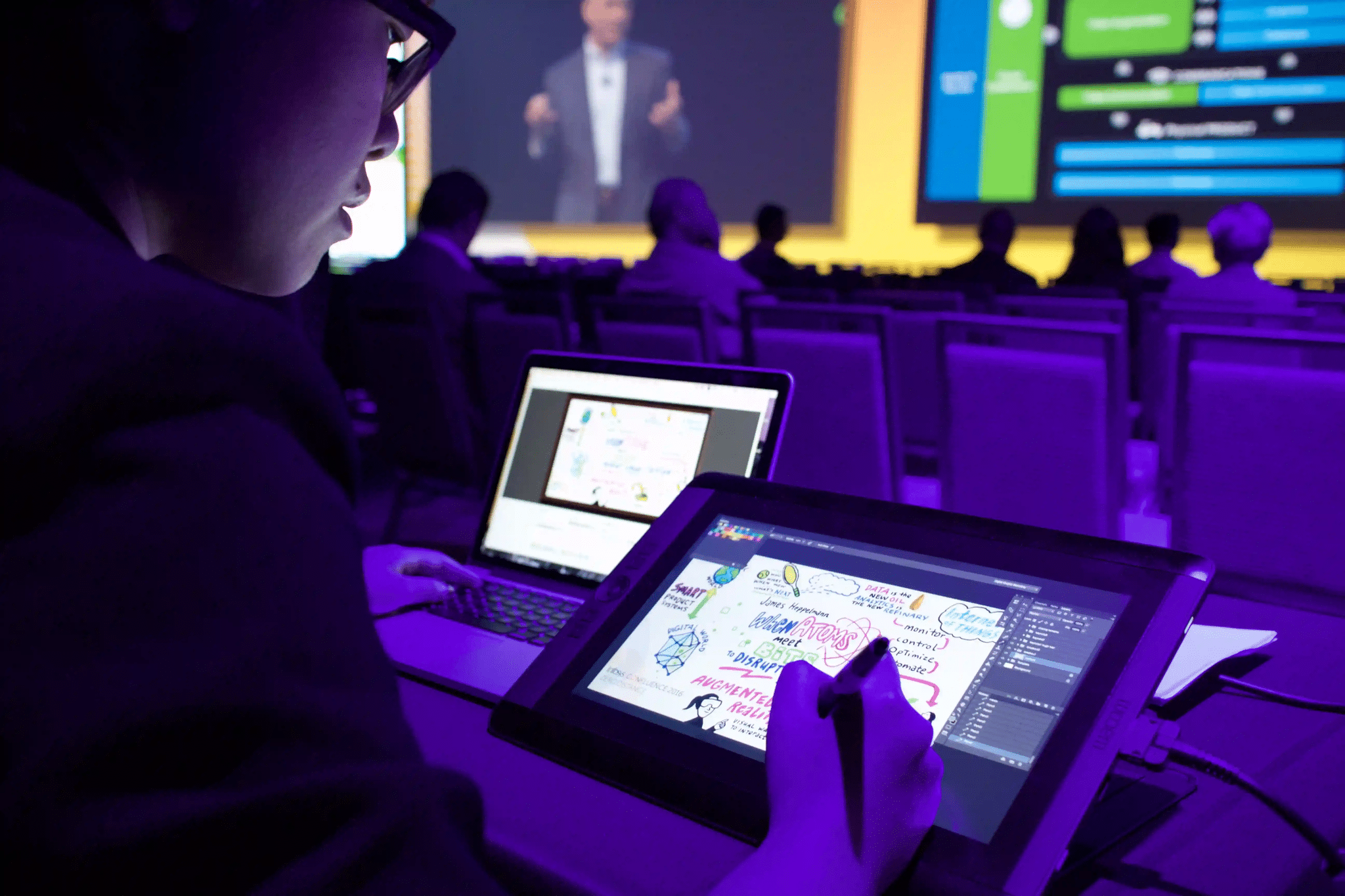
Graphic recording examples look different depending on the context — but the underlying discipline is consistent. A live session at a leadership offsite might take the form of a single 40×60 foamcore board, with strategic priorities arranged spatially and relationships between themes drawn as connective arcs. Larger conferences often call for 48×96 boards — or a team of graphic recorders producing individual session captures alongside a cumulative visual summary that builds across the event. In digital graphic recording, the work is projected live in front of a large audience or shared via screen in a virtual Zoom meeting — giving distributed groups the same real-time visual reference that in-room sessions provide. In each case, the output is not a photograph of a whiteboard. It is a crafted visual story built from active listening, editorial judgment, and graphic recording skills developed over years of practice.
Examples by Format
The table below maps common event formats to what the practice captures in each — and why the approach works.
| Format | What Is Captured | Why It Works |
| Leadership Offsite | Strategic priorities, tensions between teams, emerging consensus, and agreed next steps rendered as a visual map | Executives leave with a single, shared picture of what was decided — and why |
| Conference Keynote | Speaker’s core argument, supporting ideas, and audience insights captured in real time | Attendees retain more from sessions and share visuals long after the event ends |
| Innovation Workshop | Divergent ideas, patterns across contributions, and priority themes visualized as they emerge from the group | Visual learners and non-visual thinkers alike engage more deeply when ideas are made visible |
| Change Management Session | Current state, future vision, and the gap between them illustrated alongside key concerns and commitment points | Complex ideas about organizational change become concrete and easier to act on |
| Virtual Strategy Session | Digital graphic recording captures the same ideas and dynamics as live sessions, projected to all participants in real time | Remote teams gain the same alignment benefits regardless of location |
What Makes These Examples Work: The Principles Behind Effective Visual Capture
Looking across the strongest work in our portfolio, a set of consistent principles emerges. These are not stylistic preferences — they are the structural decisions that determine whether a visual record communicates or merely decorates.
- Visual hierarchy over comprehensiveness. The best graphic recorders do not try to capture everything. They identify what matters most and give it visual weight — through size, placement, and emphasis — so the eye knows where to go.
- Visual storytelling over transcription. Effective practice tells the story of a conversation — its arc, its tensions, its resolutions — not just its content. Visual elements like arrows, clusters, and metaphors communicate relationships that words alone cannot.
- Visual notes as a live tool, not a post-event artifact. The most impactful examples are ones where the visual record actively shaped the conversation as it developed — giving participants a shared reference to respond to, build on, and correct in real time.
- Clarity over complexity. An output that tries to communicate complex ideas through dense visual presentations often communicates none of them clearly. The most effective examples use restraint — fewer elements, more meaning.
Real-World Examples: ImageThink in Action
At SXSW, ImageThink’s graphic recorders captured over 74 keynote sessions for Ogilvy — producing a body of work that earned major media coverage, tens of thousands of social engagements, and an honorable mention for a Cannes Lion. The finished visuals still hang in Ogilvy’s offices today, long after the conference ended. For LEGO, visual facilitation during a two-day ideation workshop helped the team surface the biggest marketing idea in the company’s history — a life-size X Wing Starfighter built entirely of LEGO bricks, unveiled in Times Square. The event went viral and sparked a new Star Wars TV series. For Google’s Creative Academy, ImageThink designed the curriculum and visualized the final brand pitches for a five-day innovation training — with judges using the visual boards to select the winner. These are not outliers. They are representative of what becomes possible when graphic recording skills, deep industry knowledge, and genuine creative partnership come together in a session.
Turn your next event into a visual story people remember.
How to Use These Examples to Plan Your Own Session
The most useful thing these examples can do is help you ask better questions before your own session. When reviewing them, consider:
- What scale fits your session? A single graphic recorder works well for focused strategy sessions and workshops. Larger conferences often benefit from a team producing both individual session captures and a cumulative visual summary.
- Live or digital? Live work on 40×60 or 48×96 foamcore boards creates a physical presence in the room that shapes energy and engagement. Digital graphic recording — projected to a large audience or shared via Zoom — offers the same real-time capture and is essential for hybrid or fully remote sessions.
- How will you use the output? Visual note taking produces an asset — a high-resolution digital image your team can share, display, and reference. Plan for how it will travel before the session begins.
- What does your audience need? Visual learners engage most deeply when ideas are visible. But the practice benefits all participants — by creating a shared reference that reduces misinterpretation and accelerates alignment regardless of how individuals process information.
From Inspiration to Partnership: Working With Professional Graphic Recorders
The examples that have the most lasting impact share one thing in common: they were produced by professionals who brought more than drawing skill to the room. ImageThink’s graphic recorders are trained in graphic facilitation, active listening, and strategic communication — not just illustration. They prepare for every session with a deep understanding of your content, your audience, and your goals. The result is a visual story that does not just capture what happened. It captures what it meant — and gives your organization a communication asset that continues to deliver value long after the day ends.
Explore ImageThink’s portfolio of graphic recording examples across industries and formats, or get in touch to discuss how live or digital visual capture can elevate your next session.
Frequently Asked Questions About Graphic Recording Examples
What is an example of graphic recording?
One of the most well-known graphic recording examples from ImageThink’s work is the Ogilvy-SXSW project, where our team visualized over 74 keynote and plenary sessions live at the conference. The resulting visuals — branded as ‘Ogilvy Notes’ — earned 30,000 blog visits, 1,400 retweets, major media coverage, and an honorable mention for a Cannes Lion. The physical prints still hang in Ogilvy’s offices today.
How do graphic recordings help with engagement and memory?
Research shows that people retain significantly more information from visual communication than from text or audio alone. Live visual capture compounds this effect: when participants see their ideas reflected back in real time, they stay more engaged, contribute more actively, and leave with a clearer, more durable understanding of what was discussed.
What makes a graphic recording effective?
The most effective work is built on active listening, strong visual hierarchy, and clear visual storytelling. The practitioner synthesizes — not transcribes — choosing which ideas to elevate, how to show the relationships between them, and which visual elements communicate meaning most efficiently. Restraint is as important as skill: an output that tries to capture everything often communicates nothing clearly.
Can you use graphic recording in virtual settings?
Yes. Digital graphic recording uses the same skills and principles as live, in-room work — but rendered on a digital canvas projected to all participants via screen share or display. ImageThink has supported hundreds of virtual sessions for global organizations, delivering the same alignment and engagement benefits as in-person work.
Where can I find graphic recording portfolios or inspiration?
ImageThink’s portfolio spans 15 years of work across technology, healthcare, education, financial services, and nonprofit sectors. From single-recorder keynote captures to multi-recorder conference installations and digital sessions for remote teams, our work represents some of the most recognized graphic recording examples in the field. Get in touch to explore what is possible for your next session.
Ready to Picture Your Big Idea?
"*" indicates required fields