Picture this: a patient just left their oncologist’s office holding a six-page document explaining their new treatment protocol. Dense text. Clinical terminology. Complex dosing schedules. By the time they reach the car, most of it is already lost. This is one of the most pressing challenges in healthcare today—and visual storytelling for pharma is one of the most powerful ways to solve it.
At ImageThink, we have been helping the world’s most influential organizations since 2009—including leading names in health and pharma—translate complexity into clarity. We know what happens when science meets visual thinking. Understanding accelerates. Trust deepens. Patients engage.
What Is Visual Storytelling for Pharma?
Visual storytelling for pharma is the practice of using images, illustrations, diagrams, and visual narratives to communicate medical and scientific information in a way patients can understand, remember, and act on. It is not decoration. It is not simplification for its own sake. It is strategic communication—designed to bridge the gap between the lab and the living room.
Where traditional medical communication relies on written summaries, slide decks, and dense package inserts, visual storytelling for pharma uses the full power of the brain. Research consistently shows that people process images faster than text and retain visual information far more effectively. For pharma brands trying to improve patient outcomes, that difference is everything.
Why Visual Storytelling Matters in Patient Communication
Most patients are not scientists. When a doctor explains a mechanism of action, a clinical pathway, or a risk-benefit profile, patients often nod—and walk away confused. That confusion has real consequences: missed doses, poor adherence, and anxiety that erodes trust in their care team.
Effective patient communication is not about dumbing things down. It is about meeting people where they are. Visual storytelling for pharma respects the patient’s intelligence while removing the barriers that make complex science feel inaccessible. Done well, it transforms a confusing medical journey into a clear, navigable path.
How Visual Storytelling for Pharma Makes Complex Science Easier to Understand
Consider how a patient journey map works: instead of describing a 12-month treatment timeline in paragraphs, a single illustrated graphic shows each milestone—diagnosis, treatment start, check-ins, potential side effects, and what success looks like. The patient can see their story. They can point to where they are. They can picture what comes next.
This is the power of scientific storytelling. It does not replace clinical accuracy—it amplifies it. ImageThink’s approach combines deep listening, strategic synthesis, and real-time visual thinking to distill the most important truths from complex material and make them visible. We have applied this approach across thousands of sessions for pharma clients, from brand strategy workshops to patient education programs to change management initiatives inside large healthcare organizations.
What Types of Pharma Content Benefit From Visual Storytelling?
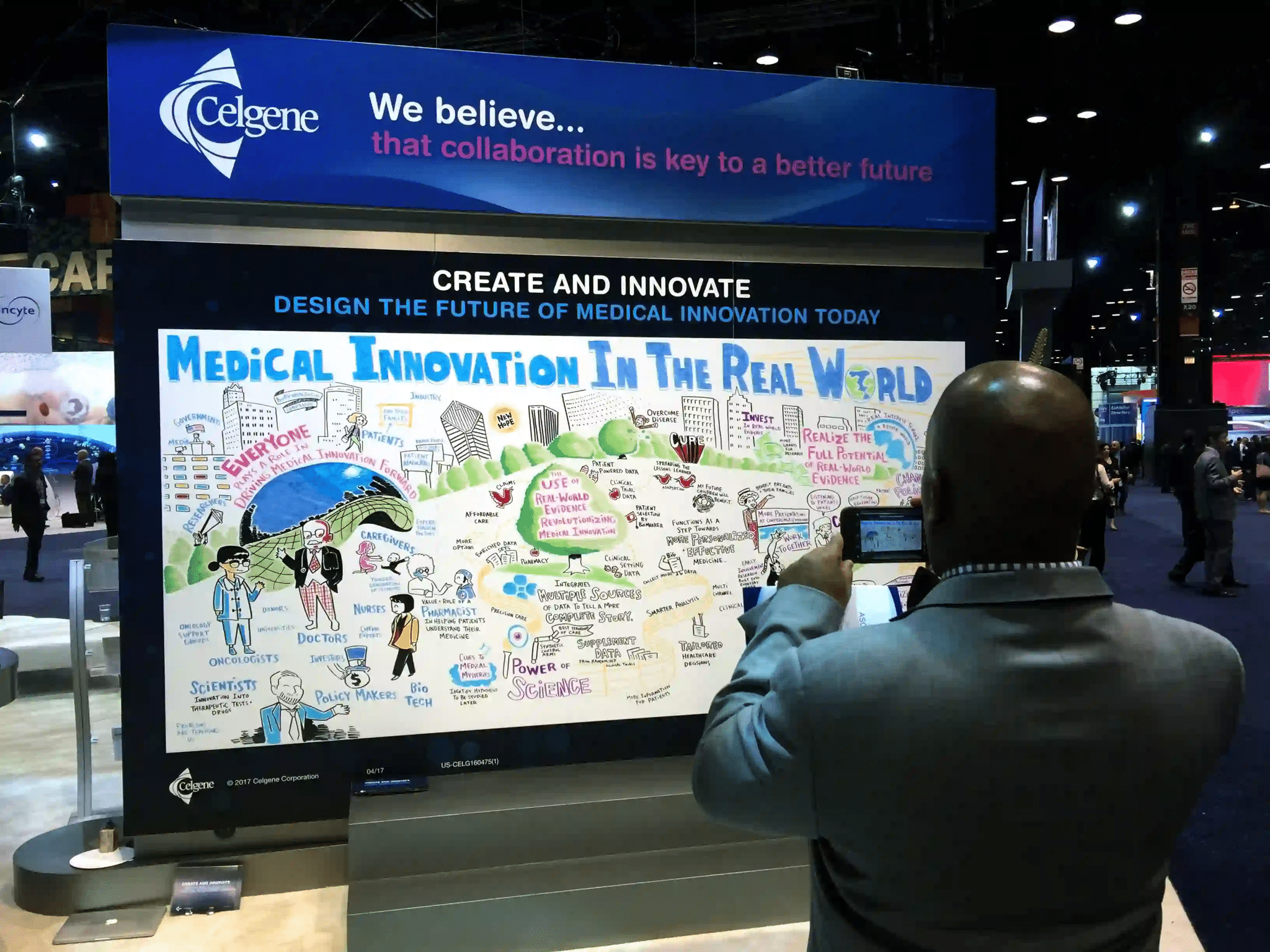
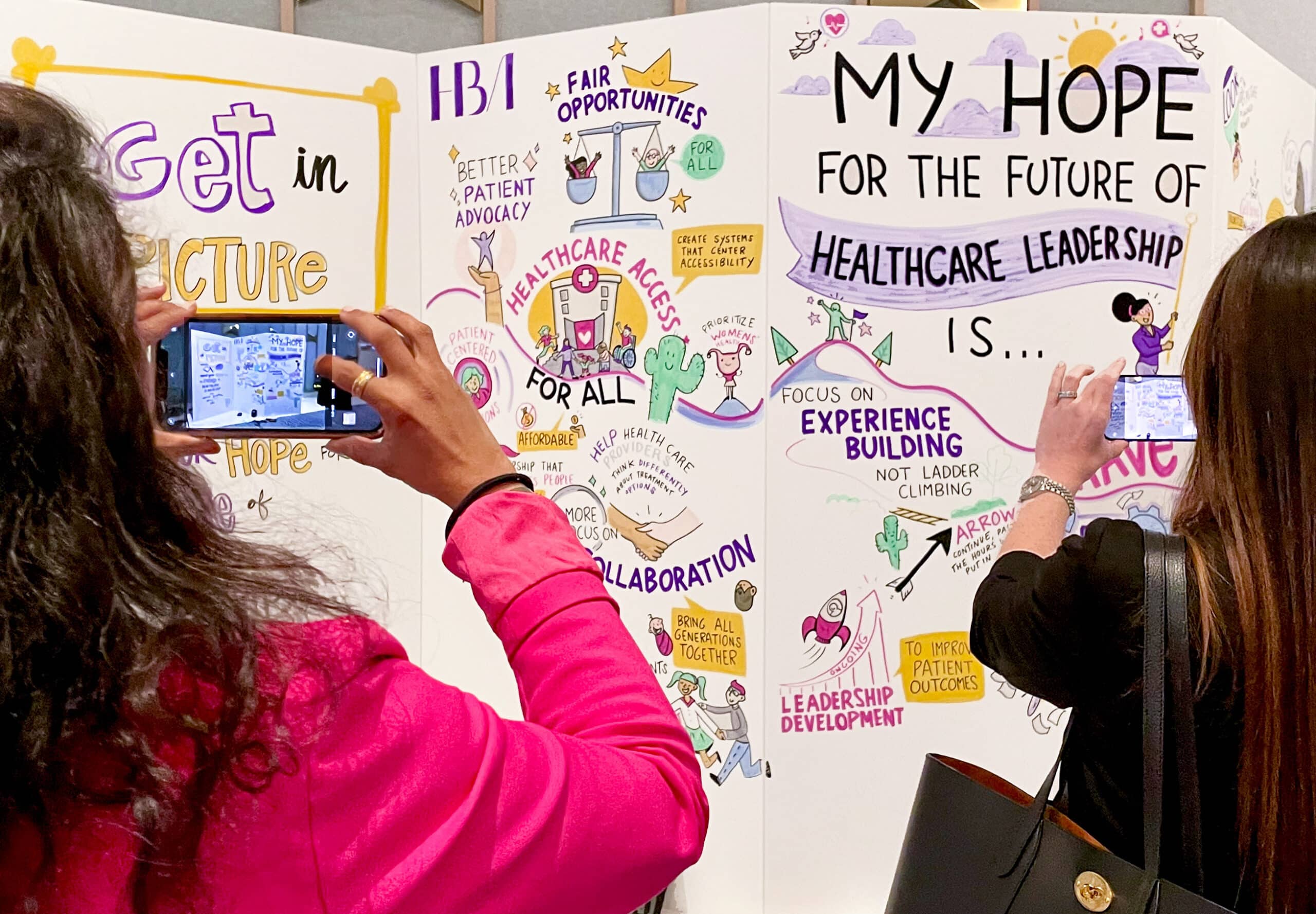
Visual storytelling for pharma works across a wide range of content types. Patient education materials—whether digital or print—benefit enormously from illustrated journey maps, mechanism-of-action graphics, and infographic-style summaries. Internal alignment materials, such as those used during drug launches or organizational change initiatives, gain clarity and momentum when key messages are captured visually in real time. Training programs for healthcare providers become more engaging and memorable when paired with visual summaries. Conference presentations and medical congresses land harder when the science is brought to life on the wall.
Turn clinical data into clarity.
Visual Storytelling for Pharma vs. Traditional Medical Communication
Traditional medical communication is built for compliance, not comprehension. Package inserts, clinical study summaries, and prescribing information are written for regulators and clinicians—not for the patient sitting across the desk. Healthcare visual communication takes a different approach: it starts with the audience, identifies what they most need to understand, and builds the message from there.
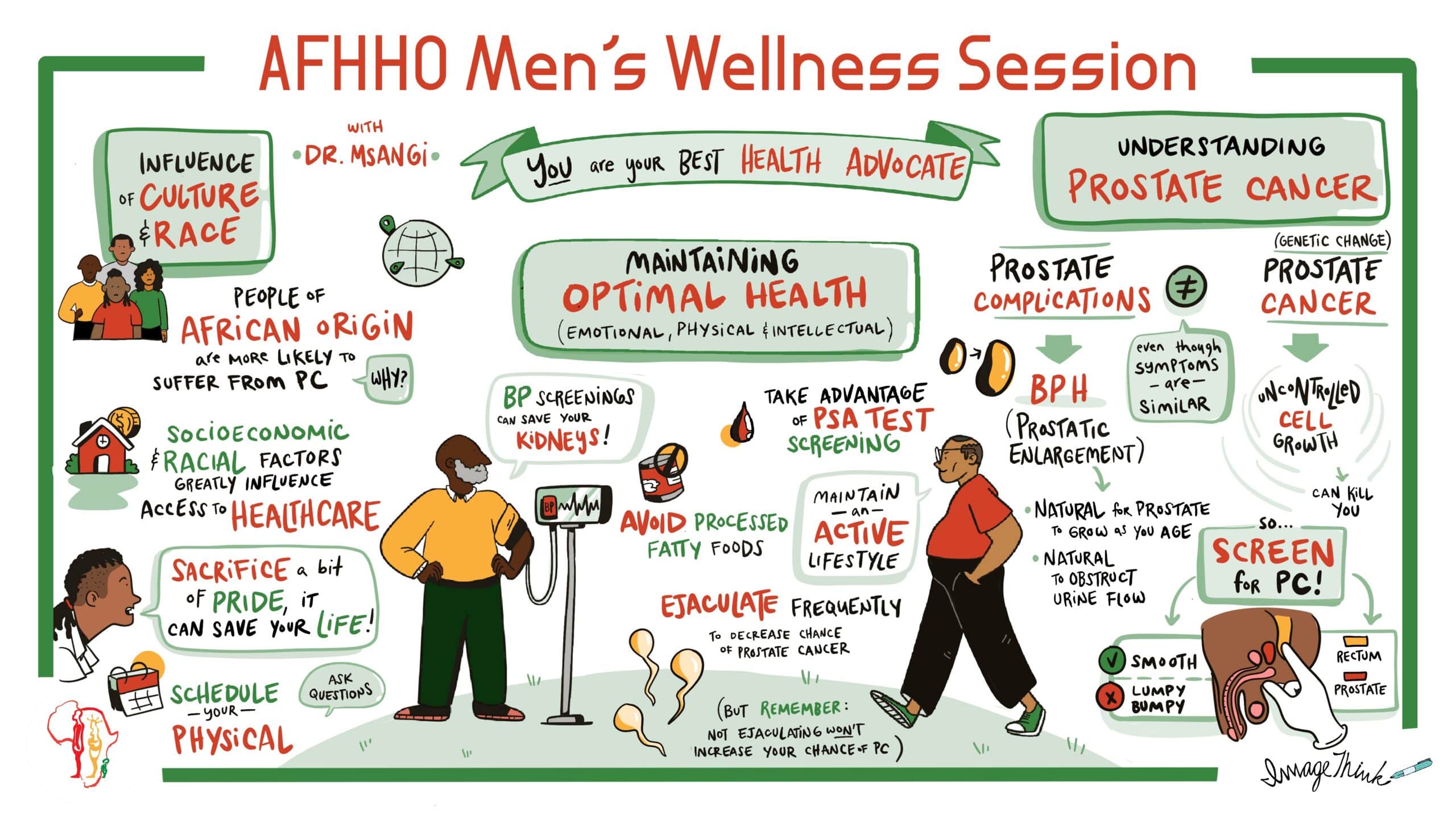
The contrast is stark. A before-and-after example tells the story clearly. A block of text describing how a biologic modulates an immune pathway becomes a simple illustrated diagram: a patient’s immune system shown in balance, then out of balance, then restored. The science has not changed. But now a patient can see it, feel it, and remember it. That is the transformation visual storytelling for pharma makes possible.
How Visual Storytelling Can Support Patient Education
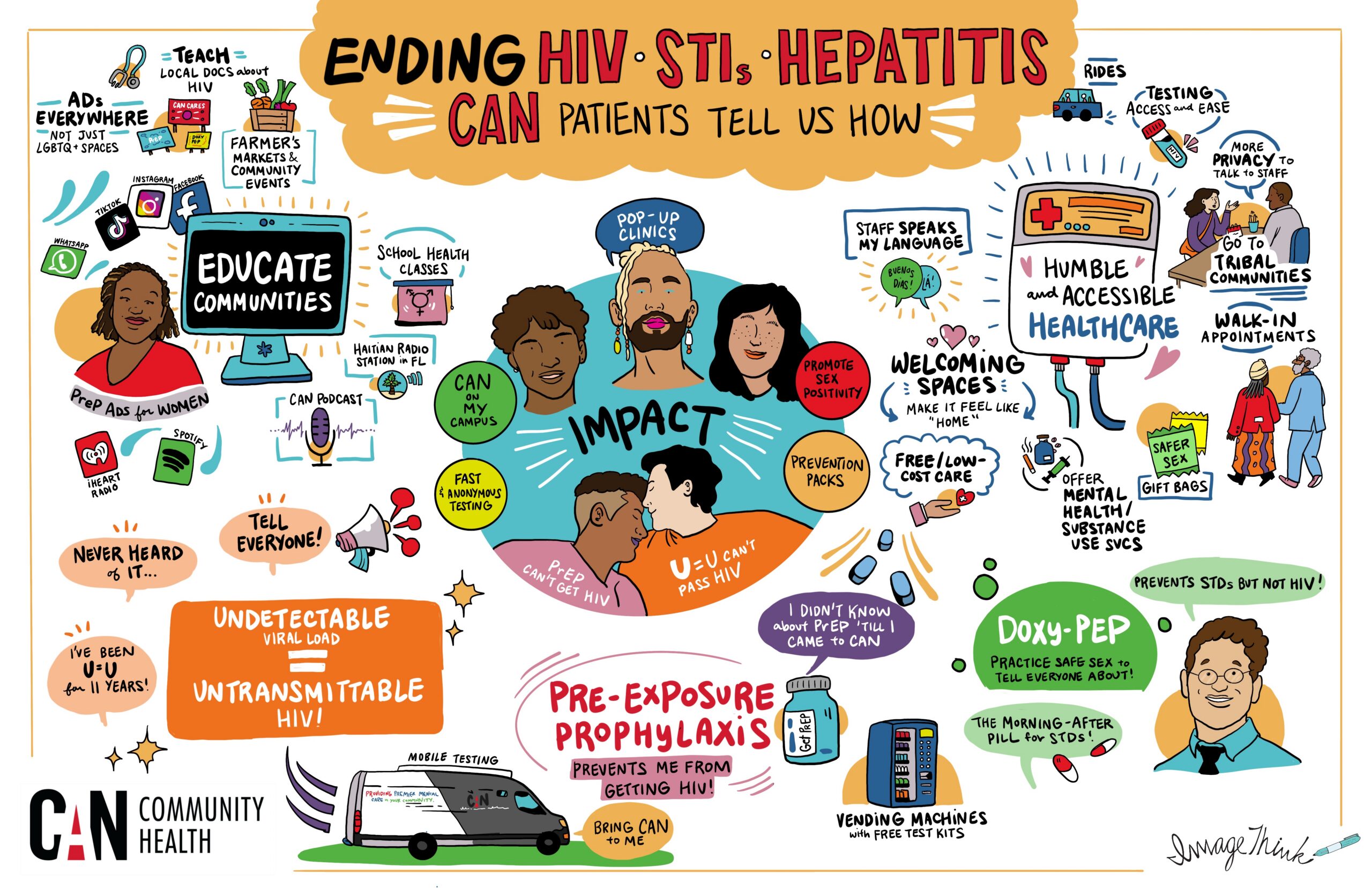
Patient education is most effective when it is specific, visual, and delivered at the right moment in the care journey. ImageThink has partnered with pharmaceutical and healthcare organizations to create illustrated patient journeys, animated explainer content, live graphic recording at medical education events, and large-scale visual summaries that capture critical information from multi-day scientific meetings. Each of these outputs serves a different need—but all share a common purpose: making healthcare visual communication work harder for the people who need it most.
What Makes Scientific Information More Accessible to Patients?
Three things consistently make scientific information more accessible: relevance, clarity, and visual structure. Relevance means anchoring the information in the patient’s lived experience—their symptoms, their goals, their fears. Clarity means eliminating jargon without eliminating nuance. Visual structure means giving information a shape that the eye can follow and the mind can hold.
ImageThink’s graphic recorders and visual strategists are trained to listen for what matters most—and to capture it in a way that creates shared understanding. We have done this for vaccine companies, global health organizations, and some of the most complex science-driven brands in the world. The result is always the same: clarity where there was confusion, alignment where there was ambiguity.
Best Practices for Communicating Science to Patients Clearly
The most effective visual storytelling for pharma begins with the patient’s perspective. Start by identifying the three to five things a patient must understand to feel confident and engaged. Build the visual narrative around those anchors. Use imagery that reflects real life—not clinical stock photos or abstract diagrams. Test your visuals with actual patients before finalizing. And always balance simplicity with accuracy: a visual that misleads is worse than no visual at all.
Why Visual Storytelling for Pharma Is Becoming More Important
As healthcare grows more complex—with personalized medicine, combination therapies, and increasingly empowered patients—the demand for healthcare visual communication will only grow. Patients today expect to understand their own care. Regulators are increasingly focused on patient-centered outcomes. And the brands that build trust through clarity will outperform those that hide behind complexity.
ImageThink has been pioneering the intersection of visual thinking and high-stakes communication since 2009. We have visualized the big ideas of world leaders, supported thousands of client sessions across health, pharma, technology, and education, and grown into a global team with affiliates on four continents. Visual storytelling for pharma is not a trend. It is the future of how science reaches people—and we are here to help you picture it.
Ready to Picture Your Big Idea?
"*" indicates required fields