A conversation outpaces the marker every time. In one hour, a group covers what would fill three notebooks: side comments, one real commitment, a metaphor everyone repeats for the rest of the day. A visual strategist can’t draw it all. The job is deciding what earns a place on the wall.
The rule: capture decisions, turning points, and repeated themes first, and let routine detail fall away. Below is the decision tree that puts this into practice, how to listen for signal, how to manage pace, and how to recover when you fall behind.
The default capture rule
When a room moves faster than you can draw, capture meaning over verbatim.
Decisions and conclusions come first. Turning points come next. Supporting detail follows once the essentials are on the wall. Filler doesn’t make the cut.
Before a marker touches paper, ask one question: will someone need this to understand what happened, or what to do next? If yes, it belongs.
This is the difference between graphic recording and transcription. A visual strategist synthesizes a conversation into a record people return to later, not a word-for-word account. The rule holds in a keynote, a workshop, or a 30-minute video call alike.
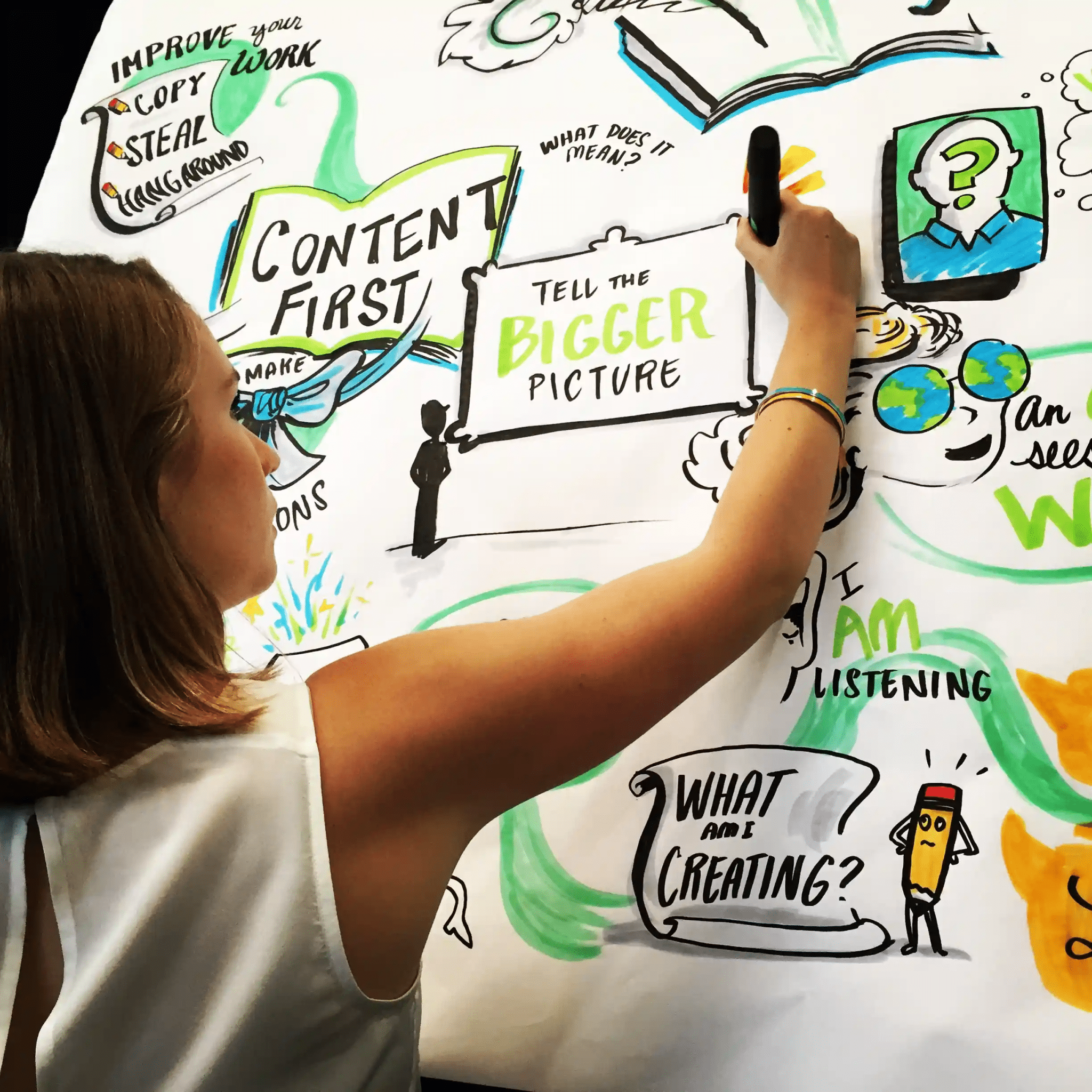
The real-time decision tree
Most graphic recorders run some version of this tree on every contribution in the room.
Is it a decision or commitment? Capture it prominently. Decisions are the highest-value content on any canvas, the thing a team points back to months later.
Is it a turning point or “aha”? Mark it. A shift in direction orients a reader who wasn’t following every twist of the conversation live.
Is it a repeated or emphasized theme? Give it weight. When an idea comes back from different people in different words, that repetition tells you what matters.
Is it a vivid metaphor, story, or number that makes an idea stick? Capture it as an anchor image. These details make a graphic record memorable rather than merely accurate.
None of the above? Summarize in a phrase, or skip it. The tree runs continuously through a session. Every contribution gets a fast pass.
People return to a graphic record to remember what was decided and where the conversation changed, not every supporting point along the way. Detail without decisions reads as noise; decisions without detail still tell the story. Capturing turning points gives a finished piece the narrative spine a reader can follow start to finish.
Listening for signal
Most of capturing well is listening well; a recorder draws with their ears as much as their hands.
Certain phrases are flags: “the key point is,” “so what we’ve decided,” “the bottom line,” “going forward.” Tone and group energy signal too: emphasis, a shift in the room, or a point repeated by a second person in their own words.
Structural moments matter as well: agenda transitions, a facilitator summarizing the discussion, or a question that reframes the group’s focus. Reviewing the agenda beforehand helps a visual strategist anticipate which themes will carry weight.
Handling speed: techniques for when it’s moving fast
The answer to speed isn’t drawing faster. It’s building a buffer so thinking time goes toward what to capture, not how.
A personal library of fast icons, containers, and connectors, practiced until automatic, frees attention for prioritization. Shorthand holds a place in the moment, refined once pace allows, and deliberate white space leaves room for the next high-value point instead of crowding the canvas.
Layering passes helps too: structure and headlines first, supporting detail and color second. A placeholder, a box or a single keyword, can hold a spot until there’s time to finish it.
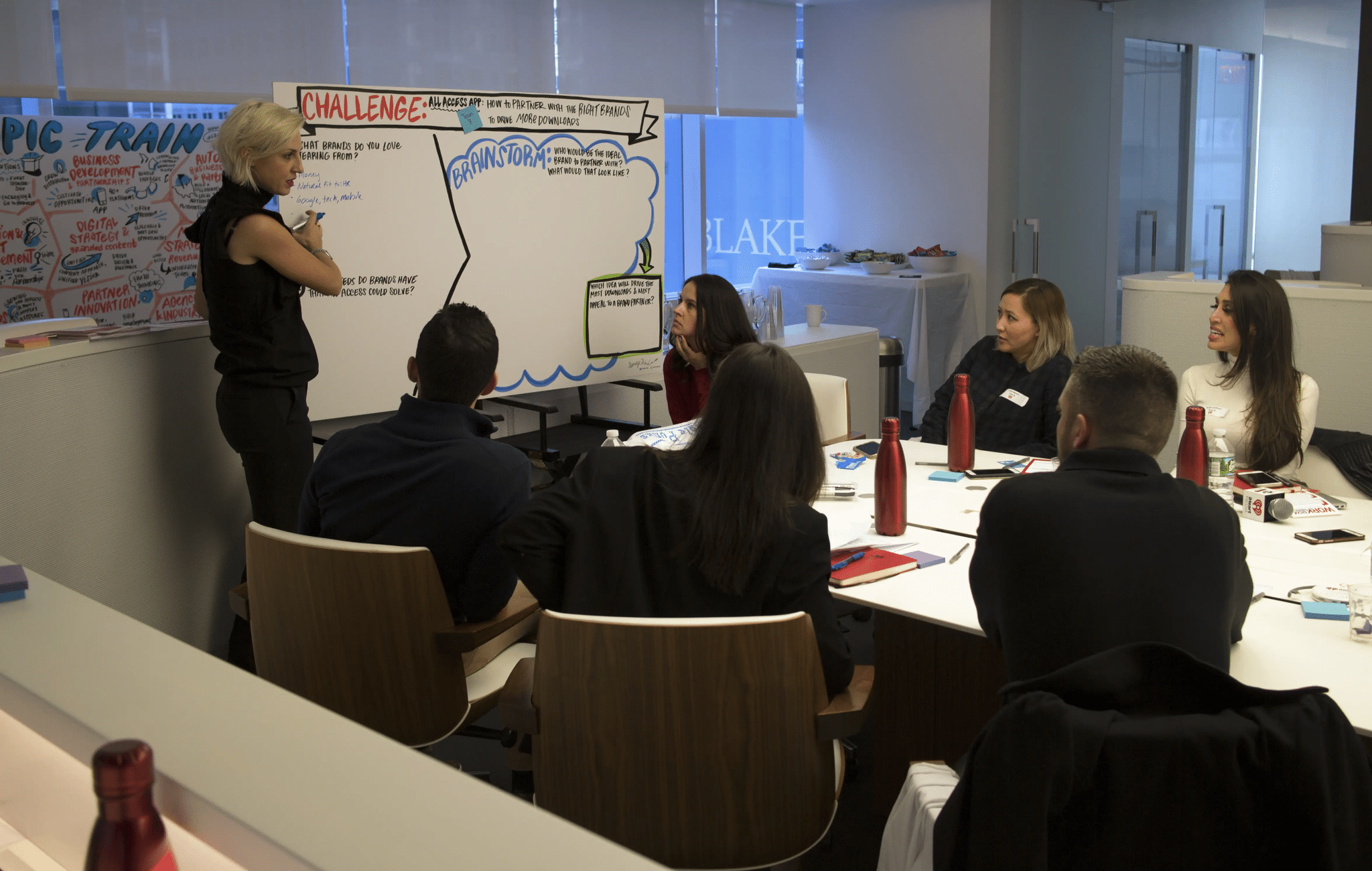
Recovering when you fall behind
Every recorder falls behind at some point. Prioritize the next decision, not the last sentence you missed. Chasing what’s already gone keeps a recorder permanently a beat behind.
Drop to keywords and connectors to catch up, then backfill detail during a natural lull or a change of speaker. Not everything makes the wall, and that’s fine: a clean, accurate record beats a crowded, frantic one. If a decision was missed entirely, a quiet confirmation with the facilitator beats guessing.
Adapting the tree to the format
The tree stays constant. How it’s weighted shifts with the room.
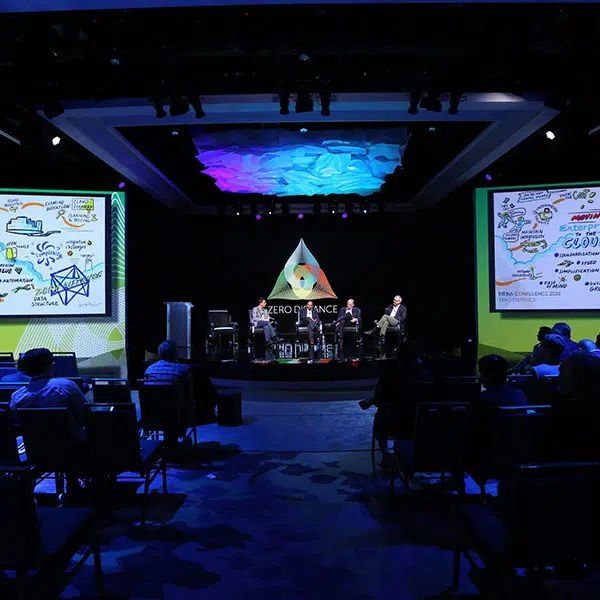
- Conference keynote: capture the speaker’s throughline and a handful of memorable anchors. No recorder catches every point.
- Working session or workshop: weight decisions, action items, and unresolved points of disagreement.
- Short online meeting: work a tighter canvas with fewer elements, sharpening prioritization toward decisions and next steps.
- Strategy session: weight direction, priorities, and trade-offs over operational detail.
Key takeaways
The tree, in priority order: decision or commitment, turning point, repeated theme, vivid anchor. Filler gets skipped.
Capturing first is a listening and prioritization skill, backed by drawing that’s fast because it’s practiced. Rehearse the tree until the questions run without thinking, and the rest of the craft has room to follow.
FAQ
What should you capture first in graphic recording?
Decisions and commitments first, then turning points, then repeated themes and vivid anchors. Filler comes last, if at all.
How do recorders keep up when the conversation is too fast?
By building a buffer: pre-practiced icons, shorthand, layered passes, and placeholders refined during lulls.
Is graphic recording the same as transcription?
No. Graphic recording synthesizes meaning into a visual map. Transcription captures words verbatim.
What do you do when you fall behind?
Prioritize the next decision over the missed sentence, drop to keywords, and backfill during natural breaks.
How do you know what’s important while it’s happening?
Watch for cues like “the key point is” or “we’ve decided,” emphasis, repetition, group energy, and agenda transitions.
Does everything said need to make it onto the canvas?
No. A clean, accurate record of what mattered beats a crowded one. Selective capture is the skill, not a shortcoming.
Ready to Picture Your Big Idea?
"*" indicates required fields