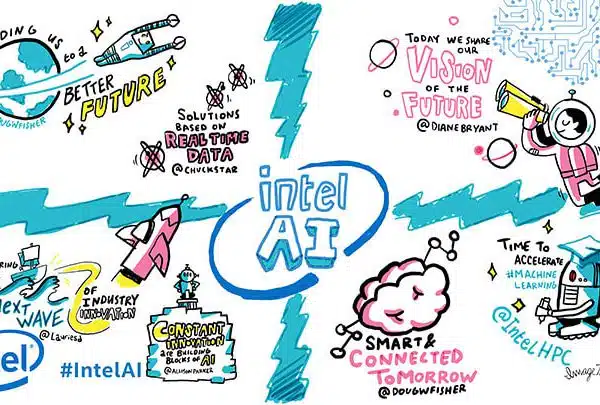
Graphic recording pricing is driven by five factors: how long the event runs, whether the work happens live or is produced afterward, how many visual strategists the session requires, whether delivery is in-person, virtual, or hybrid, and what final deliverables you need. Vendors weigh these differently, which is why two quotes for what looks like “the same thing” can land far apart.
If you’re comparing quotes or building a budget for graphic recording at an upcoming meeting, conference, or offsite, you’ve probably noticed the range. One firm quotes a flat day rate. Another asks a dozen questions before naming a number. A third won’t quote at all until they’ve seen your agenda. None of them are wrong. Graphic recording is a live, skilled service, closer to hiring a facilitator or a keynote speaker than ordering a printed banner, and pricing reflects that. This piece breaks down the real cost drivers across the industry, not just how one firm prices its work, so you know what you’re actually paying for and what questions to ask before you sign anything.
ImageThink opened its doors in 2009, and most of what we know about pricing this work fairly comes from sitting in the room itself: boardrooms, conference halls, pitch meetings, offsites where the stakes were genuinely high. That collective experience is why clients choose us expecting a certain standard of work, and why we think it’s worth explaining plainly how this pricing actually works instead of leaving buyers to guess.
Event Length
The clearest driver of cost is how much time a visual strategist spends on your event, and most vendors price it in half-day and full-day rates. A three-hour session typically falls under the half-day rate, while anything longer moves into a full-day rate, and multi-day conferences are priced across however many days they run, often with a modest per-day discount since travel and setup costs are shared across the engagement.
What length doesn’t automatically mean is a more complex format inside that same day. A single keynote and an afternoon of several rotating panels can call for the same day rate, since the time on-site is what’s being priced, not the number of individual sessions captured within it. That’s worth confirming directly with any vendor, since some firms do price per session rather than per half-day or full day, and that distinction changes what you’re comparing.
Live vs. Studio-Produced Work
Not all graphic recording happens in the room. Live work, where a visual strategist captures the conversation in real time on a large-format board, generally costs more per hour than studio work, where a team member illustrates a recording, transcript, or brief after the fact on their own schedule.
Live work commands a premium because it requires a practitioner with the skill to synthesize and draw complex ideas in real time, with no chance to pause, revise, or research mid-session. Studio-produced pieces (like a polished summary graphic built from a webinar recording) trade that real-time pressure for a longer production timeline, which is often reflected in the price.
Team Size and Number of Visual Strategists
A single visual strategist can typically cover one room for one session. Once you have concurrent breakouts, an unusually large mural, or a full-day event where continuous coverage matters, you need more than one practitioner, and pricing scales accordingly.
This is one of the most common places budgets get out of sync with expectations. A client planning a conference with four simultaneous breakout rooms is really asking for four sessions’ worth of graphic facilitation, not one. Ask any vendor directly how many visual strategists your agenda actually requires before you compare their quote to anyone else’s.
It’s also worth asking whether a vendor prices by the number of boards produced or by the day itself. Some firms charge per board, so a session that generates seven boards costs more than one that generates a single board, even if both fill the same amount of time. At ImageThink, we price by the date instead: whether a day calls for one board or seven, the service fee stays the same, aside from our shorter virtual rate for sessions under two hours. Neither model is wrong, but it changes what you’re comparing when you put two quotes side by side, so it’s worth asking outright.
Virtual, In-Person, or Hybrid Delivery
Delivery format changes both the cost structure and what you’re paying for. In-person work includes travel, shipping of drawing boards or supplies, and on-site logistics. Virtual graphic recording removes those costs but introduces its own requirements: high-quality equipment, a reliable screen-share or streaming setup, and often faster post-session digital turnaround since there’s no physical board to photograph and ship.
Hybrid events, where some attendees are in the room and others join remotely, are common, and they don’t have to be complicated. When a room is split between in-person and remote attendees, ImageThink typically covers the event virtually, since a strong virtual setup can serve both audiences well without the added travel and shipping costs of an in-person booking.
What matters most for a hybrid event isn’t format so much as logistics, and that’s exactly what a planning call is for. We talk through whether the visual strategist (and any other remote participants) will be able to hear the speakers in the room clearly, and we work directly with the on-site team to make sure attendees in person have a strong graphic recording experience too: is there a projector, is the visual displayed throughout the session or only shared at the end, and how will the finished image be distributed afterward. Getting these details right on the front end is what makes a hybrid event feel seamless for everyone in the room and everyone watching remotely.
Industry Experience and Preparation
Price isn’t the only thing that varies across vendors. So does what you’re actually getting for it. A visual strategist’s portfolio shows you their drawing style, but it doesn’t tell you whether they have real fluency in your industry, whether that’s pharmaceutical strategy sessions, technical product reviews, or regulatory discussions. When a term needs explaining mid-session, or the connection between two ideas gets missed, that gap can show up in the final work, regardless of how strong the drawing itself is.
This is why briefing and preparation matter as much as the hour of live drawing. At ImageThink, our visual strategists are trained across sectors and take part in the planning calls ahead of an event, so they arrive already aligned with the client’s language, priorities, and the way ideas in that industry typically connect to each other. That preparation is part of what a quote is paying for, even when it isn’t broken out as its own line item, and it’s a fair question to ask any vendor: has the person drawing my session worked in this space before, and will they be briefed beforehand?
Deliverable Type
What you walk away with shapes the quote as much as the day itself. A large-format hand-drawn board is one deliverable. A set of high-resolution digital scans is another. A polished, standalone infographic or set of strategic visuals built from the day’s content for internal circulation or an executive summary is a third, and usually the most involved.
Be specific about what you need after the event ends. If you want the raw board, digital files, an edited summary graphic, and rights to reproduce the work in an internal newsletter or on your intranet, say so upfront. Each of those is a separate line item for most vendors, and assuming they’re bundled in is a common source of quote confusion.
Delivery format is worth asking about too. At ImageThink, every event concludes with a password-protected online gallery, typically delivered within 72 business hours, so digital files are easy to access and share securely rather than sitting in a single email attachment. That access isn’t a one-time thing either. We’ve had clients reach out years after an event asking whether we still have their gallery, and once we confirm it’s the same person or organization requesting it, we’re glad to re-share it.
Travel and Reimbursable Expenses
For any in-person event, travel and lodging are real costs on top of the service fee itself, and they’re often where two otherwise-similar quotes diverge the most. A small, single-location firm booked for a job outside its home city has to build airfare, hotel, and per diem into the quote. That’s a legitimate cost, but it’s an added one.
This is one advantage of working with a firm that has a genuinely global team rather than a single home base. If a client needs graphic recording in a city where a firm already has a local visual strategist on the ground, there’s no flight or hotel to reimburse, which can meaningfully lower the total cost of the same event.
At ImageThink, we don’t build a travel or lodging estimate into a quote upfront. Once a quote goes out, confirmation might come back within the hour or take a month, and either way, that time is used to look at availability and geography together, so we can pair the right visual strategist and event planning team to your location before travel ever becomes a factor in the final cost. It’s a fair question to ask any vendor directly: do you have someone local to where this event is happening, or is travel going to be part of my quote?
Rush Timelines and Turnaround
Booking a visual strategist six weeks out is a different request than booking one for next Tuesday. Rush timelines affect availability, and short-notice bookings often carry a premium, particularly for studio-produced deliverables that would normally take days to complete properly.
The same is true for fast turnaround after the event. ImageThink’s standard gallery delivery is within 72 business hours of an event wrapping, and if you need final digital files faster than that, for example the same day or within a few hours, expect that to show up as a separate cost, since it typically means a practitioner reprioritizing other client work to meet your deadline.
Custom Quotes vs. Flat-Rate Pricing: Why Graphic Recording Doesn’t Work Like a Price List
Most graphic recording and visual strategy firms quote per project instead of publishing a fixed rate card, and there’s a real reason for that. Two events described in a single sentence, “one day, one room, one speaker,” can require completely different scopes once you factor in room size, number of concurrent sessions, whether the work is live or produced afterward, and what deliverables the client actually wants at the end.
A flat, published price list would either overcharge simple projects to cover the complex ones, or underprice complex projects to compete on the simple ones. Neither serves the client well. What you should expect instead is a short scoping conversation, sometimes just a few questions over email, that lets a vendor build a quote around your actual agenda rather than a generic average.
If you want to see how this plays out in practice, ImageThink’s pricing page walks through the specific factors that shape a quote and includes a way to request one directly.
Frequently Asked Questions
How much does graphic recording cost on average?
There’s no single industry-wide average, because cost depends heavily on event length, team size, delivery format, and deliverables. Rather than anchoring to an average, ask vendors to quote against your specific agenda so you’re comparing real numbers, not estimates built on different assumptions.
Why do quotes vary so much between vendors?
Quotes vary because firms weigh cost drivers differently, and because “graphic recording” can mean a single practitioner sketching one session or a multi-person team producing large-format murals across several concurrent tracks. Two quotes for the “same” event can reflect two very different scopes.
What should I ask for in a quote?
Ask for a breakdown by day or session, the number of visual strategists included, whether the work is live or studio-produced, what deliverables are included (physical boards, digital scans, or strategic visuals), and whether travel or rush fees apply. A detailed quote protects you from surprises later.
Does virtual graphic recording cost less than in-person?
Sometimes, but not always. Virtual work removes travel and shipping costs, but it can require specialized equipment and faster digital turnaround, which offsets some of the savings. Ask your vendor to compare formats directly for your event rather than assuming virtual is automatically cheaper.
Do multi-day events get a lower per-day rate?
Often, yes. Many vendors offer a modest discount for consecutive multi-day bookings, since travel and setup costs are shared across the engagement instead of repeated for each day.
Is graphic recording more expensive than traditional meeting facilitation?
The two services solve different problems and aren’t always directly comparable. Graphic recording adds a visual, retained record of the conversation, which is often the reason clients choose it alongside or instead of standard meeting facilitation. Whether it costs more depends on the scope of both services for your specific event.
Does travel add to the cost of graphic recording?
Yes, if the vendor doesn’t already have a visual strategist local to your event city, travel and lodging are typically billed on top of the service fee. Ask whether a firm has local coverage where your event is happening, since that can change the total cost of an otherwise identical quote.
Does the number of boards created onsite affect the price?
It depends on the vendor. Some firms charge per board produced, so more boards means a higher cost. Others charge by the day regardless of board count. Ask which model a vendor uses before comparing quotes, since it changes what the number actually represents.
What’s the difference between a quote for graphic recording and one for a broader visual strategy project?
Graphic recording quotes are typically scoped around a specific live event or session. A visual strategy engagement is often broader, covering a longer project, multiple touchpoints, or strategic visuals developed over time, so the scoping conversation and quote structure look different.
If you’re still sorting out what to even call the service you need, our terms-of-art guide breaks down graphic recording, graphic facilitation, and visual strategy in plain language. And if you want to see how these cost drivers apply to your own event, our pricing page outlines ImageThink’s own factors and lets you request a quote directly. For a broader look at how the field itself has evolved, see our guide on what graphic recording means today.
Have questions about your specific event? Get in touch and we’ll help you scope it accurately from the start.
Ready to Picture Your Big Idea?
"*" indicates required fields