Product development is a discipline built on collaboration — and collaboration is only as good as the shared understanding it produces. Has your team ever left a workshop with different interpretations of what was decided? Built a roadmap that reflected the loudest voice in the room rather than the best thinking in it? Produced a beautifully structured meeting summary that no one opened again?
That is not a people problem. It is a visibility problem. And it is exactly why so many of the world’s most innovative product teams are asking why use graphic recording for product development workshops — and not going back to whiteboards and typed notes once they have the answer.
At ImageThink, we have been helping organizations turn complex discussions into clear visual outcomes since 2009. Here is what graphic recording brings to product development workshops that no other tool does.
What Is Graphic Recording for Product Development Workshops?
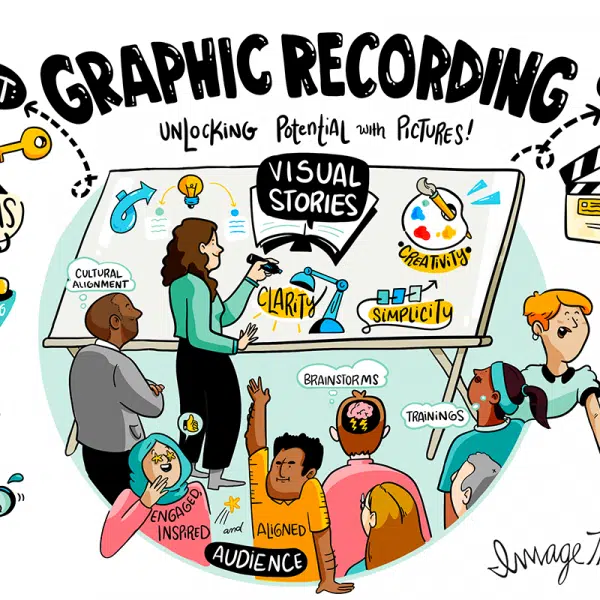
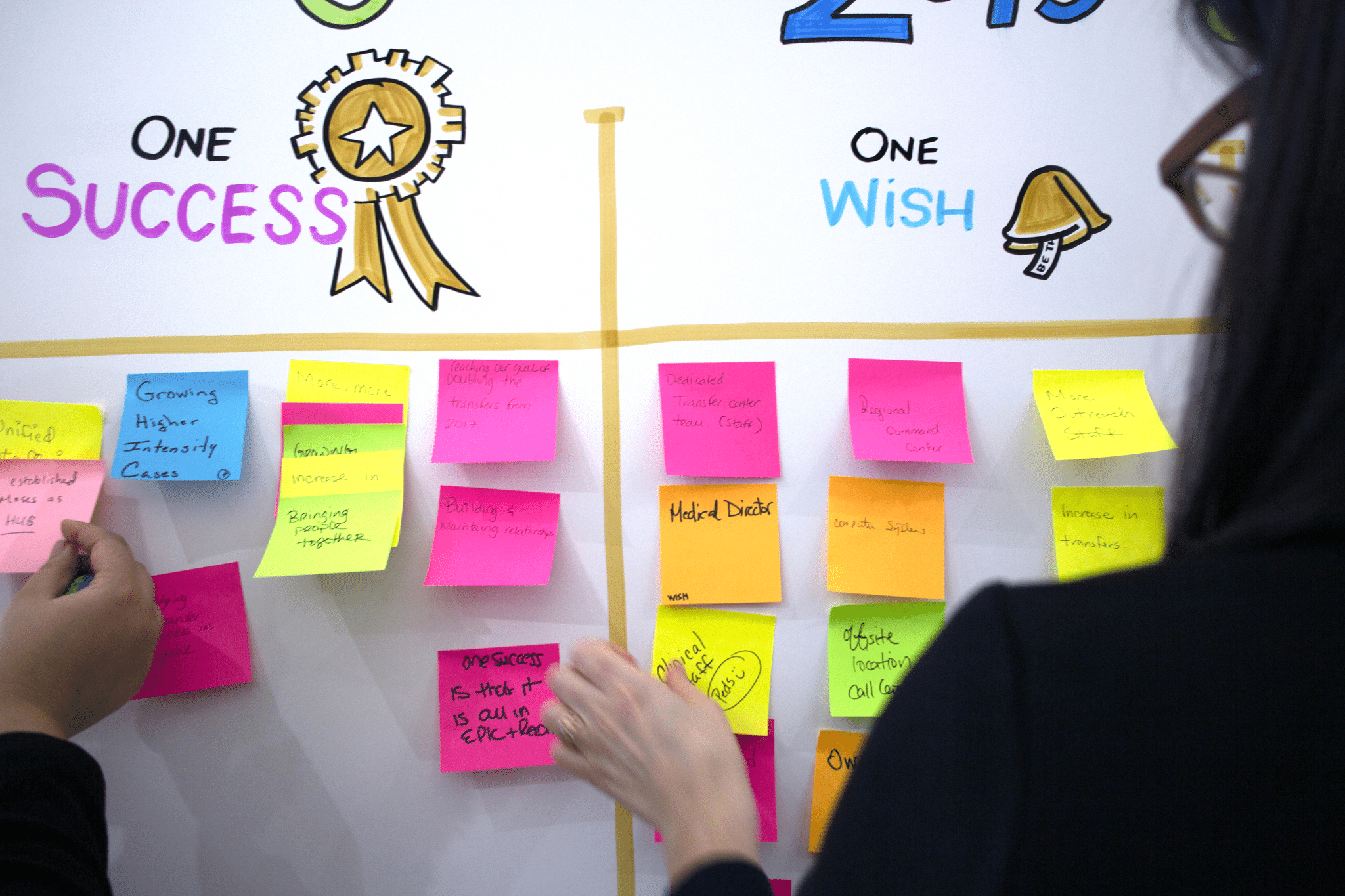
Graphic recording for product development workshops is the practice of capturing ideas, decisions, and discussions in real time using hand-drawn visuals — words, icons, diagrams, and frameworks — on large-format paper or digital boards. A skilled graphic recorder listens actively as the conversation unfolds, synthesizing key themes and surfacing the relationships between ideas as they emerge.
The result is not a transcript. It is a living visual map of the workshop — one the entire team can see, respond to, and build-on in the moment, and reference long after the session ends. In the context of product development, where cross-functional teams must align quickly on complex, fast-moving information, that shared visual record is a significant strategic asset.
How Graphic Recording Helps Teams Capture Complex Ideas
Product development workshops generate more information than any written note system can reliably capture. User research findings, technical constraints, market positioning, stakeholder priorities, and design decisions all surface in the same conversation — often simultaneously, often in tension with each other.
Graphic recording holds all of it. Because the visual record is built in real time and visible to everyone in the room, it creates an immediate feedback loop: participants can see whether their ideas have been understood accurately, correct misinterpretations on the spot, and build more precisely on what has already been captured. The discipline of making ideas visible as they emerge also has a clarifying effect on the discussion itself — vague concepts get sharpened, and the room moves toward greater precision.
How Graphic Recording Improves Alignment Across Cross-Functional Teams
Cross-functional alignment is one of the hardest problems in product development. Engineering, design, product management, marketing, and leadership all bring different languages, priorities, and mental models to the same workshop. Without a shared visual reference, it is easy for each discipline to leave the room having heard what it expected to hear.
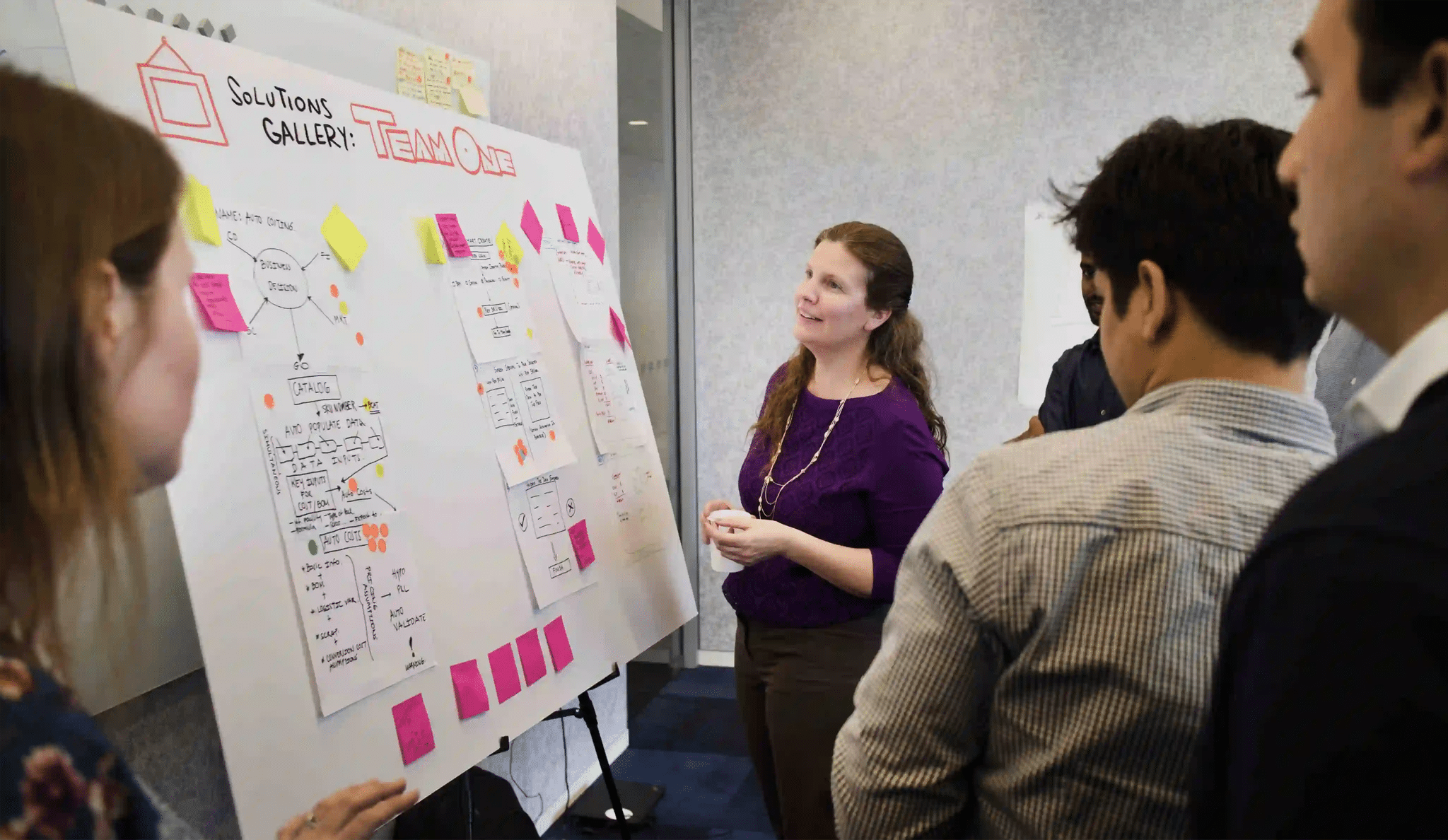
Graphic recording removes that ambiguity. When the entire conversation is rendered visually in a format everyone in the room can see and interrogate, the gaps between what different teams understood become visible — and correctable — before the workshop ends. In our experience at ImageThink, this single dynamic accounts for more of the value organizations derive from graphic recording than any other factor. Alignment that would have taken weeks of follow-up emails and clarifying conversations happens in the room, in real time.
What Types of Product Development Workshops Benefit Most?
The short answer is any workshop where teams need to align across disciplines and make decisions from complex information. In practice, the formats that consistently benefit most include:
- Product roadmap and prioritization sessions, where competing ideas need to be weighed visually against each other
- User research synthesis workshops, where patterns across qualitative data need to surface quickly
- Sprint planning and retrospectives, where the team needs a shared picture of progress, blockers, and next steps
- Feature definition and scoping sessions, where technical and design constraints need to be mapped alongside user needs
- Go-to-market planning workshops, where cross-functional alignment on messaging, timing, and ownership is critical
In each of these formats, the value of graphic recording compounds across the session. The visual record does not just capture what was discussed — it actively shapes how the discussion develops, surfacing connections and contradictions that might otherwise remain invisible.
Turn complex conversations into shared clarity.
Graphic Recording vs. Traditional Meeting Notes in Product Workshops
| Graphic Recording | Traditional Notes | Whiteboard Summary | |
| Captures ideas in real time | ✓ | ✓ | ✓ |
| Shows relationships between ideas | ✓ | ✗ | Partial |
| Visible to whole room during session | ✓ | ✗ | ✓ |
| Sharable and enduring after session | ✓ | ✓ | ✗ |
| Drives cross-functional alignment | High | Low | Medium |
| Surfaces patterns and gaps visually | ✓ | ✗ | Partial |
| Supports faster follow-up | ✓ | Partial | ✗ |
| Keeps participants engaged | High | Low | Medium |
Traditional meeting notes record the sequence of a conversation. Graphic recording captures its structure — the ideas, the relationships between them, the decisions made, and the questions left open. For product development workshops, that structural clarity is what enables teams to act.
How Graphic Recording Helps Teams Spot Patterns, Gaps, and Priorities
One of the least discussed benefits of graphic recording for product development workshops is its ability to make patterns visible that would otherwise stay buried in the flow of conversation. When a theme recurs across different parts of a workshop, a skilled graphic recorder surfaces it visually — clustering related ideas, drawing connections between disparate contributions, and flagging tensions that deserve resolution.
This pattern-recognition function is particularly valuable in product development, where the distance between a good idea and the right idea often comes down to seeing how it fits — or does not fit — within the larger picture. Graphic recording makes that larger picture visible in real time, giving teams a shared map to navigate rather than a list of items to process.
How Visual Capture Supports Faster Follow-Up After Product Workshops
The period immediately after a product development workshop is critical. Decisions need to be communicated, owners need to be assigned, and momentum needs to be maintained. Graphic recording compresses the time this takes significantly. Because the visual record is complete at the end of the session, teams leave with a sharable, high-resolution asset that can be distributed, displayed, and referenced immediately — without waiting for notes to be written up, reviewed, and circulated.
ImageThink has supported product development workshops for some of the world’s most innovative organizations — from technology and healthcare to education and financial services. If you want your next workshop to produce sharper alignment and faster follow-up, we can help. Get in touch to find out more.
Frequently Asked Questions About Graphic Recording for Product Development Workshops
What is graphic recording for product development workshops?
Graphic recording for product development workshops is the practice of capturing ideas, decisions, and discussions in real time using hand-drawn visuals — words, icons, diagrams, and frameworks — on large-format paper or digital boards. A skilled graphic recorder synthesizes what is being said as it happens, producing a shared visual record the entire team can see, respond to, and build on during the session.
Why use graphic recording in a product workshop?
Product development workshops generate large volumes of complex, fast-moving information across multiple disciplines. Graphic recording makes that information visible as it emerges — keeping teams aligned, reducing misinterpretation, and ensuring that the ideas generated in the room are captured accurately and accessibly for everyone involved.
How does graphic recording help teams during workshops?
It externalizes the conversation. When ideas are spoken only, they are vulnerable to being misheard, misremembered, or lost entirely. Graphic recording gives complex discussions a physical form the whole team can evaluate, challenge, and prioritize together — in real time, before the session ends.
What types of workshops benefit from graphic recording?
Product roadmap sessions, sprint planning, user research synthesis, feature prioritization workshops, go-to-market planning, and cross-functional strategy sessions all benefit significantly. Any workshop where teams need to align across disciplines and make decisions from complex information is a strong candidate.
How is graphic recording different from regular meeting notes?
Traditional notes record what was said sequentially. Graphic recording captures what it meant — surfacing the relationships between ideas, the tensions and trade-offs in the room, and the patterns that emerge across a discussion. The result is not a transcript. It is a visual map of the conversation that teams can navigate, reference, and act on.
Ready to Picture Your Big Idea?
"*" indicates required fields