Most teams don’t struggle with a lack of information. They struggle with a lack of application. A great training can still fade fast if people leave with notes, not new habits.
That’s why experiential learning matters. When people learn by doing, they don’t just understand an idea—they practice it, test it, and adapt it to real constraints.
Pair that with visual learning and you get something even more powerful: shared understanding that’s easy to remember, easy to discuss, and easy to turn into action.
Here’s how experiential learning and visual tools turn theory into practice across workshops, classrooms, and organizations.
What Is Experiential Learning?
Experiential learning is a learning approach where people build knowledge through direct experience, reflection, and iteration. Instead of only hearing concepts explained, participants engage in activities, simulations, and real scenarios.
At its core, experiential learning is learning by doing—followed by making meaning from what happened and deciding what to try next.
Why Experiential Learning Works
Experiential learning works because it creates feedback. People notice what they did, what worked, what didn’t, and how their choices affected outcomes.
It also improves transfer. When learners practice in a realistic context, they’re more likely to use the skill later at work. That’s the difference between understanding a framework and actually changing behavior.
For organizations, interactive learning increases engagement because participants aren’t passive. They’re contributing, experimenting, and building confidence in real time.
The Role of Visuals in Experiential Learning
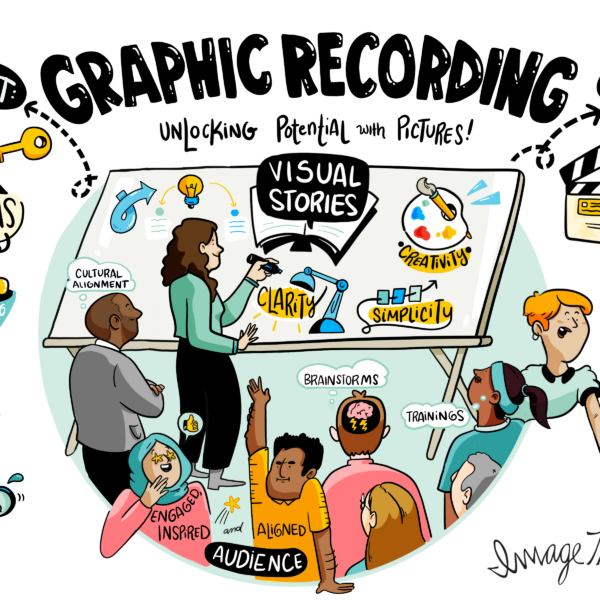
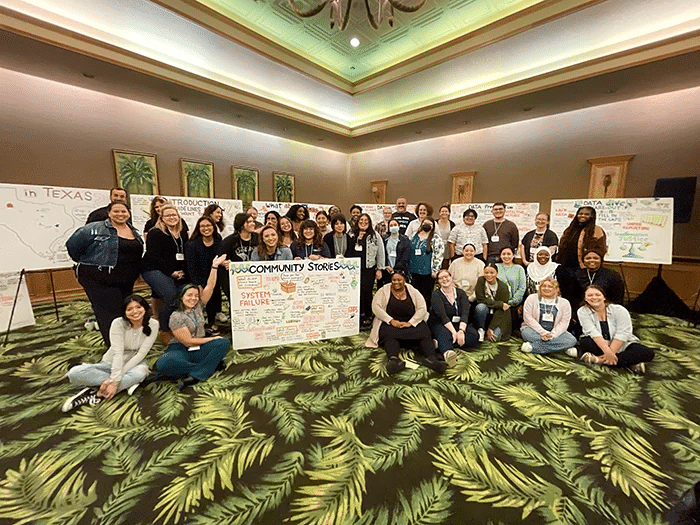
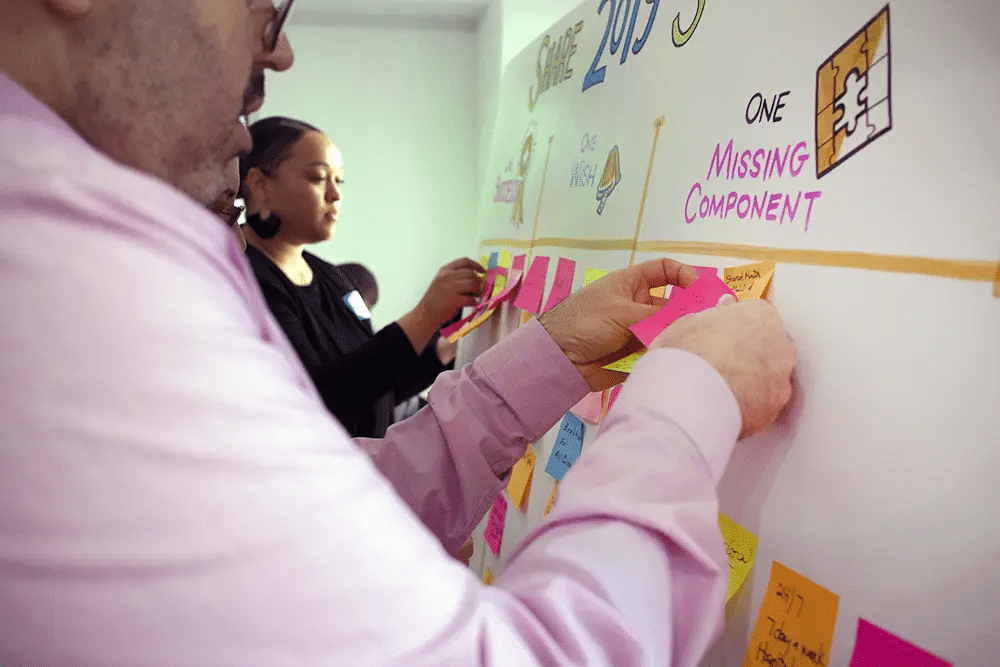
Visual learning supports experiential learning by making thinking visible. When a group can see the process, the decisions, and the patterns emerging, they can reflect faster and align more easily.
Visuals also reduce cognitive load. A simple map, model, or diagram can hold complexity in one place so participants can focus on learning by doing rather than trying to remember everything.
This is where visual facilitation becomes a practical advantage: it captures what people are discovering as they work, not just what the facilitator planned to teach.
Common Experiential Learning Models
Many learning design programs use structured models to turn experience into insight. Two of the most common are:
- Kolb’s Experiential Learning Cycle: experience, reflection, conceptualization, and experimentation. A simple diagram of this cycle helps groups see where they are and what step comes next.
- 70–20–10: learning through experience (70), relationships/coaching (20), and formal training (10). It’s a helpful lens for planning interactive learning beyond a single workshop.
These models matter because they keep experiential learning from becoming “just activities.” They create a repeatable learning design flow that turns practice into progress.
Visual Tools That Power Experiential Learning
The right tools make experiential learning easier to run and easier to remember. Here are a few that consistently support learning by doing.
- Journey maps and process maps to surface real friction points and test improvements
- Role cards and scenario boards to simulate stakeholder perspectives
- Decision trees to practice choices and see consequences
- Before/after visuals that compare theory-only training with experiential sessions
- Templates for reflection (What happened? So what? Now what?) to turn experience into insight
To make these tools more than “nice visuals,” pair them with visual facilitation that guides attention. For example, a facilitator can capture patterns as they emerge (“We keep seeing handoff delays here”) and then turn that insight into a live prompt (“What would we change if we owned this step end-to-end?”). The visual becomes a shared mirror for the group’s behavior.
Ready to Make Learning Visible?
You can also use visual facilitation to tighten the reflection loop. Instead of asking people to remember what happened, you map the experience in real time—actions taken, decisions made, and moments of friction—then invite the group to annotate the visual with what they noticed. That makes the learning visible and reduces the “I think we said…” confusion.
Used well, these tools strengthen visual learning because participants can point to what they mean, not just describe it.
From Theory to Practice: Designing Visual Learning Experiences
Great experiential learning doesn’t start with slides. It starts with outcomes: what should people be able to do differently after the session?
From there, build a sequence: brief concept, hands-on activity, reflection, and a second round of experimentation. This is learning by doing with intention.
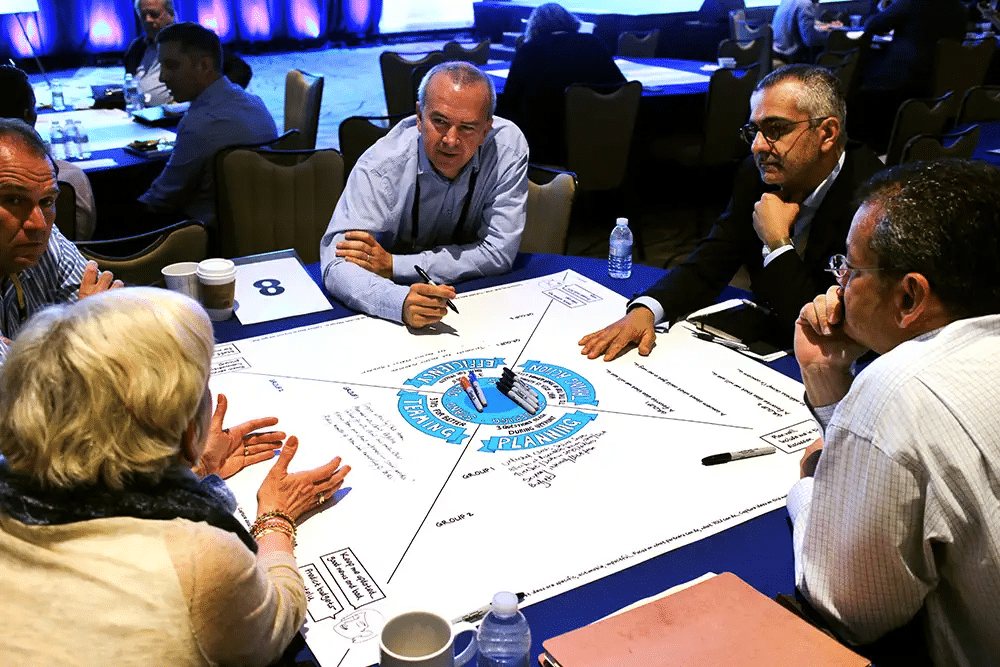
To make it stick, design the visuals as the “container” for the experience. For example, a shared canvas can hold hypotheses, observations, and next steps, so the group can see their learning evolve.
This is also where visual facilitation elevates learning design. It helps the facilitator track patterns across groups, synthesize insights, and keep the room aligned on what’s being learned.
A practical tip: decide ahead of time what you’ll capture live. If the goal is behavior change, capture decisions, tradeoffs, and “rules of thumb” the group is forming—not every comment. That’s where visual facilitation supports transfer: it turns a messy experience into a clean set of takeaways people can reuse.
Experiential Learning in Action: Use Cases
In organizations, experiential learning is especially effective when you need behavior change, not just awareness.
Common use cases include leadership development, change management, customer experience work, and cross-functional alignment. These settings benefit from interactive learning because the work is social and complex.
In classrooms and training programs, experiential learning paired with visual learning supports different learning styles. It gives students multiple ways to process: doing, seeing, discussing, and reflecting.
Measuring the Impact of Experiential Learning
To measure experiential learning, look beyond “did they like it?” and focus on evidence of application.
Start with immediate indicators: did participants demonstrate the skill during the session, and can they explain what changed in their approach?
Then track follow-through: are people using the tools after the workshop, and are managers seeing different behaviors? Even simple check-ins can reveal whether learning by doing translated into action.
For deeper measurement, connect the learning design to business outcomes—faster decisions, fewer handoff errors, improved customer experience, or stronger team habits.
Visual, Experiential Learning Turns Ideas into Action
Experiential learning turns theory into practice by giving people a safe place to try, reflect, and improve. Visual learning makes that practice visible, memorable, and easier to share.
When you combine learning by doing with visual facilitation, you don’t just teach concepts—you help groups build new ways of working they can carry into the real world.