Great graphic recording isn’t just about drawing quickly. It’s about hearing what matters, in the moment, and translating it into a visual that helps a group remember, align, and act.
That’s why a listening mindset is the #1 skill behind clean, useful boards. When you listen for meaning (not just words), you capture the story the room is trying to tell.
In this post, you’ll learn what a listening mindset is, how it supports real-time synthesis, and the listening habits that make visual work clearer in keynotes, workshops, and fast-moving meetings.
What Is a Listening Mindset?
A listening mindset is the intention to understand before you capture. It’s a mental stance: curious, present, and focused on meaning.
In graphic recording, a listening mindset helps you notice what’s central, what’s supporting, and what’s just noise. It’s the difference between a board full of sentences and a visual that reflects the group’s actual direction.
It’s closely related to active listening, but with an extra layer: you’re listening for structure you can draw.
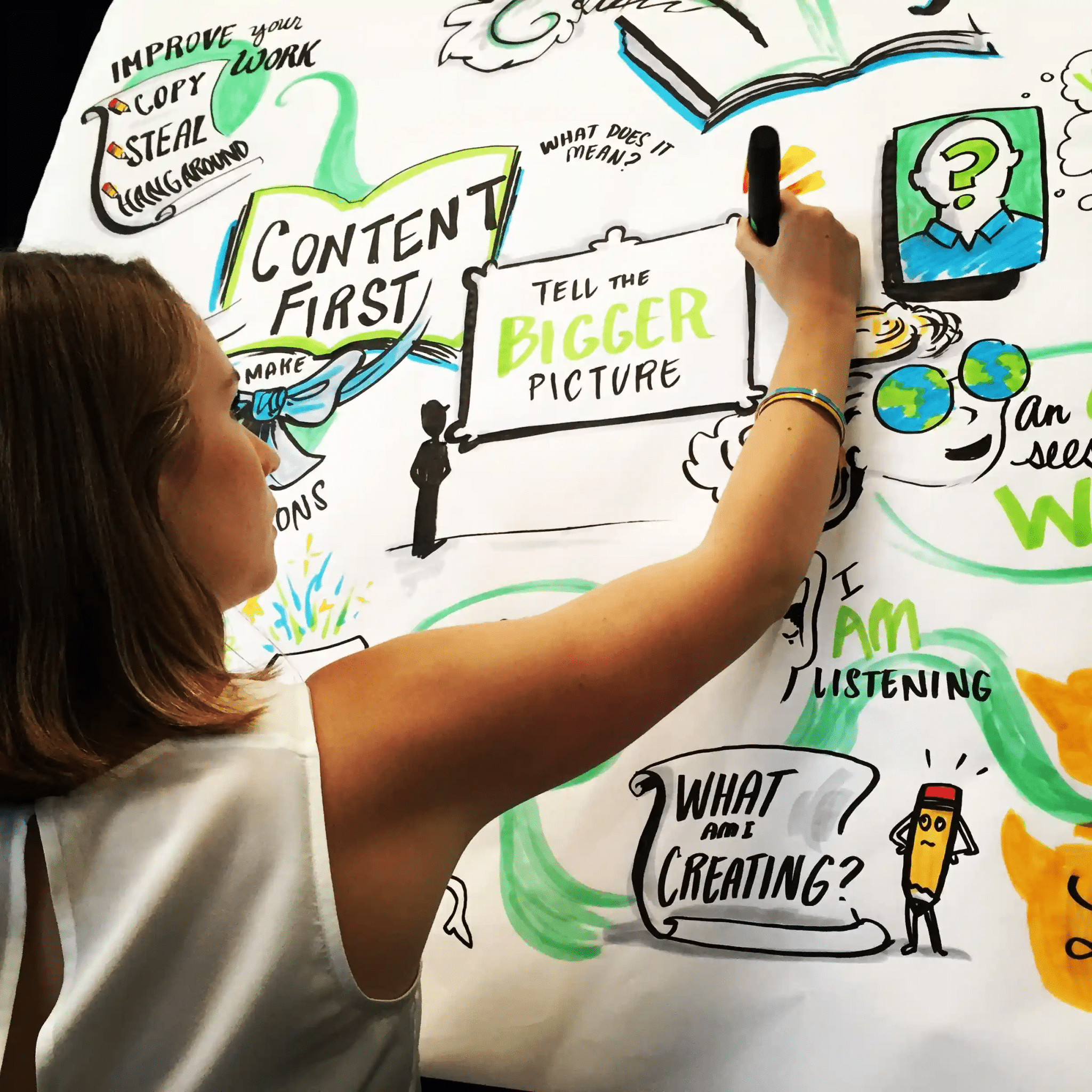
Why Listening Is the Graphic Recorder’s Superpower
When the pace is high, your hand can’t keep up with every word. The only way to stay accurate is to listen for the few ideas that organize everything else.
A strong listening mindset also builds trust. People feel “seen” when the graphic recording reflects their intent, not just their phrasing.
And because the output often becomes the shared artifact after the meeting, listening well improves retention and follow-through long after the session ends.
The Difference Between “Capturing Words” and “Capturing Sense”
Capturing words is transcription. Capturing sense is interpretation—with care.
In practice, capturing sense means you’re doing real-time synthesis. You’re: – Grouping ideas – Naming patterns – Showing relationships (cause/effect, priorities, tradeoffs, next steps)
A quick way to check your approach: if someone reads the board later, will they understand what changed, what mattered, and what to do next.
The 3 Levels of Listening in Graphic Recording
Most graphic recording requires you to move through three listening levels.
- Level 1 is facts: names, numbers, dates, definitions, and the “what.” This is where accuracy matters most.
- Level 2 is patterns: repeated themes, shared language, and contrasts (old vs new, risk vs reward). This is where active listening helps you spot what the room keeps returning to.
- Level 3 is meaning: the “so what,” the decision, the commitment, or the shift in perspective. This is the heart of a listening mindset—and the part that makes the visual useful.
Stop Losing the Best Ideas in Meetings
Listening Mindset Skills Every Graphic Recorder Builds
A listening mindset is made of trainable micro-skills.
- Selective attention: choosing what to capture and what to let go
- Signal detection: noticing emphasis, repetition, and emotional energy
- Neutral framing: capturing meaning without editorializing
- Language tracking: writing the phrases leaders want repeated, especially in strategy and sales contexts
Together, these skills support real-time synthesis while keeping the graphic recording faithful to the speaker.
Practical Listening Techniques for Live Events
Before the session, set yourself up to listen well. Ask for: – The agenda – The purpose – The “must-capture” moments
During the event, use short active listening loops: listen for a complete thought, summarize it in your head, then draw the simplest structure that holds it.
A helpful technique is “headline first.” Write a short headline for the idea, then add 2–3 supporting bullets or icons. This protects clarity when the pace spikes.
How to Listen for Structure in Fast Conversations
Fast conversations can feel like a firehose. Structure is how you slow it down.
Listen for transitions: – “first/second/third” – “the challenge is” – “what we learned” – “here’s the decision” – “next steps”
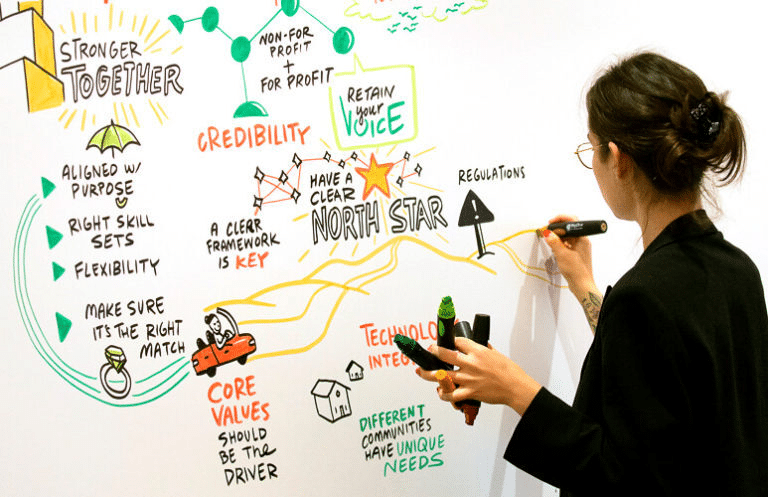
Then choose a container that matches the structure: a timeline for sequence, a two-column compare for tradeoffs, a simple map for stakeholders, or a three-part framework for strategy. If you’re unsure, start with a simple title + three supporting points—then refine once the speaker lands the thought.
This is where graphic recording and visual facilitation overlap: both are about making thinking visible.
Great Graphic Recording Starts with Great Listening
The best visuals don’t come from speed alone. They come from a listening mindset that prioritizes meaning, structure, and what the room needs to remember.
When you combine active listening with real-time synthesis, your graphic recording becomes more than notes—it becomes a tool for clarity.
If you want a visual team that listens for what matters and captures it with intention, ImageThink brings experienced visual facilitation and graphic recording to sessions where alignment and decisions matter most.